
A Dubai company plans to hire 20 employees over the next six months. Its HR manager already handles recruitment, payroll coordination and employee records. Now the business needs someone to manage work permits, residence visas, renewals and government documentation.
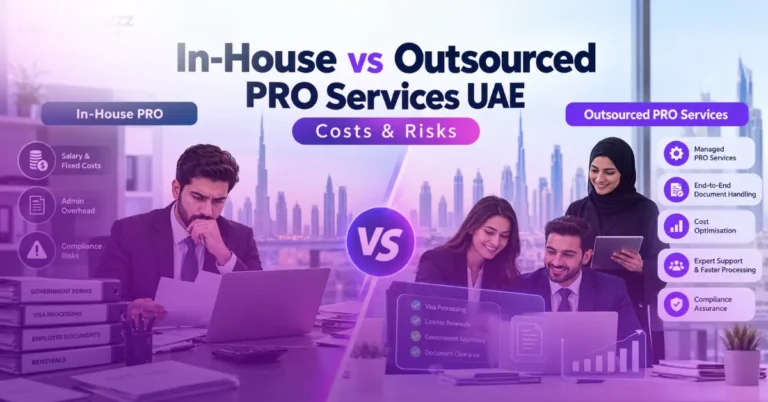
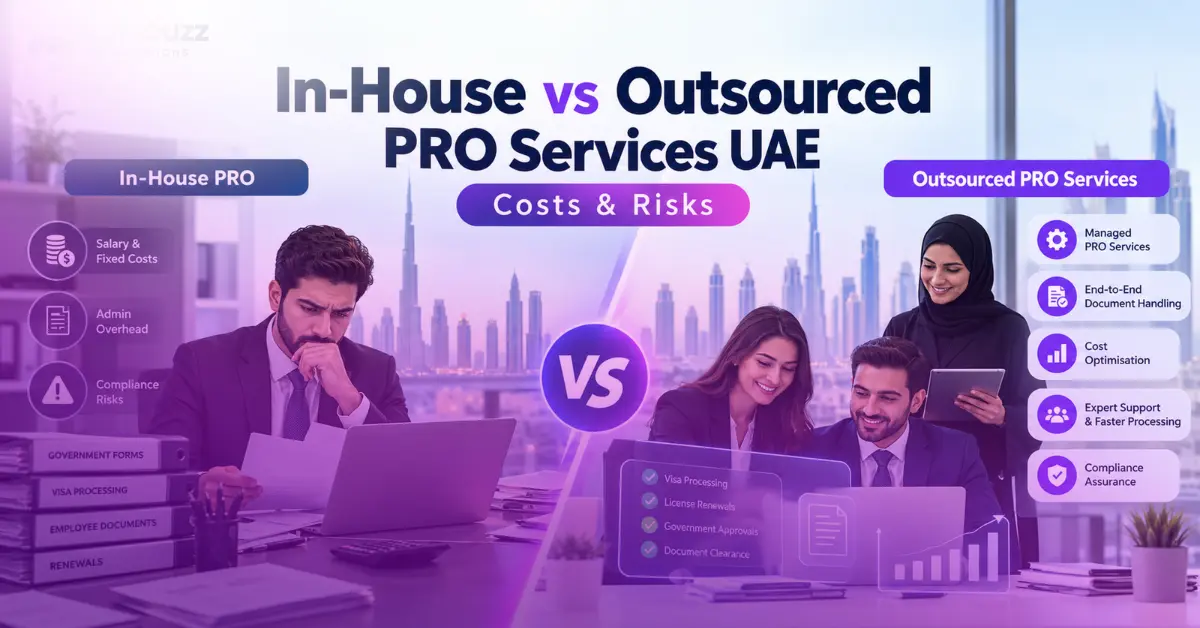
Should it recruit a full-time Public Relations Officer (PRO), or engage an external PRO services provider?
This decision has financial and operational consequences. Hiring an internal PRO introduces a recurring employment cost. Outsourcing can provide more flexible access to administrative support, but it also creates dependencies on an external provider.
For UAE employers, the right choice depends on transaction volume, internal capacity, compliance requirements and the quality of available service providers.
This guide compares in-house PRO vs outsourced PRO services in Dubai and the UAE. It covers costs, operational risks, legal responsibilities and a practical method for identifying which arrangement offers better value.
Table of Contents
- What are PRO services in the UAE?
- In-house PRO vs outsourced PRO services: key differences
- The real cost of hiring an in-house PRO
- How much do outsourced PRO services cost?
- Annual cost comparison and break-even analysis
- Compliance and operational risk comparison
- UAE legal and regulatory considerations
- When hiring an in-house PRO makes sense
- When outsourcing PRO services makes sense
- Is a hybrid PRO model better?
- How to choose the right PRO arrangement
- Common mistakes UAE employers should avoid
- Employer decision checklist
- Frequently asked questions
- How Combuzz HR Solutions can help
1. What Are PRO Services in the UAE?
PRO services involve coordinating government-related administrative processes and documentation required for a company to operate and employ people in the UAE.
The term PRO stands for Public Relations Officer. In this context, it refers to a professional who manages administrative communications, applications and follow-ups involving government authorities.
Corporate PRO responsibilities may include:
- Employment work permit applications, renewals and cancellations
- Employee residence visa coordination
- Emirates ID application support
- Medical fitness appointment coordination
- Establishment card documentation
- Trade licence-related administrative support
- Labour contract and employee record submissions
- Government documentation and attestation coordination
- Tracking document expiry dates
- Employee onboarding and offboarding documentation
A PRO helps the company coordinate these processes but does not replace the government authority responsible for approving them.
Which UAE Authorities Are Involved?
The relevant authorities depend on the employer’s location, licence and workforce arrangements.
Ministry of Human Resources and Emiratisation (MOHRE)
MOHRE administers key employment and work permit procedures for employers within its jurisdiction.
Federal Authority for Identity, Citizenship, Customs and Port Security (ICP)
ICP manages federal identity, immigration and residence services.
General Directorate of Residency and Foreigners Affairs (GDRFA)
Dubai’s GDRFA handles relevant immigration and residency services within Dubai.
Dubai Department of Economy and Tourism (DET)
DET administers mainland business licensing functions in Dubai.
Free zone authorities
Free zone companies may need to complete employment and administrative procedures through their respective authorities.
The practical challenge is not simply filling in forms. Employers need accurate documentation, reliable tracking and an understanding of which procedure applies to each employee and business entity.
This is why the choice of PRO operating model deserves careful consideration.
2. In-House PRO vs Outsourced PRO Services: Key Differences
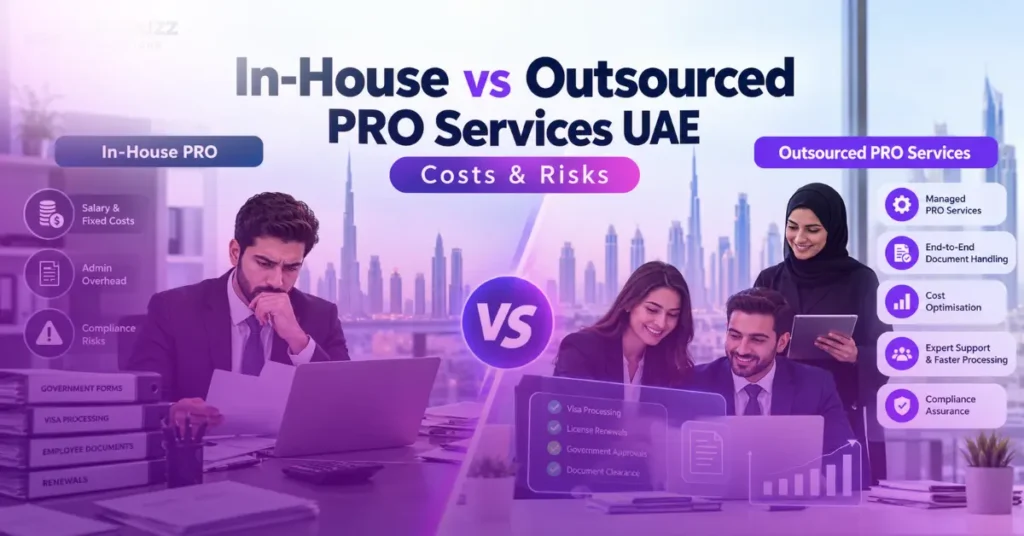
An in-house PRO is directly employed by the business. An outsourced PRO provider performs agreed administrative services under a commercial agreement.
Both arrangements can support compliance and operational efficiency when managed correctly.
| Factor | In-house PRO | Outsourced PRO services |
|---|---|---|
| Employment relationship | Direct employee | External service contract |
| Typical cost structure | Salary plus employment overheads | Retainer or transaction-based fees |
| Daily management | Direct internal supervision | Managed through agreed service arrangements |
| Expertise | Depends on employee experience | Depends on provider team and capabilities |
| Workload capacity | Limited by available internal resources | Can be adjusted within contracted capacity |
| Leave and absence | Requires backup arrangements | May offer team-based coverage |
| Internal process knowledge | Can develop strong familiarity | Requires structured knowledge transfer |
| Reporting | Managed through company systems | Defined by contract and provider reporting |
| Data handling | Internal access controls | Internal and third-party access controls |
| Legal responsibility | Employer retains applicable obligations | Employer retains applicable obligations |
| Flexibility | Higher fixed employment commitment | Depends on commercial agreement |
The biggest difference is how each model converts administrative requirements into costs and operational responsibilities.
An employee may provide excellent service during periods of high activity but remain a fixed expense when transaction volumes decline.
A provider may reduce fixed overheads while charging separately for high volumes, specialised tasks or urgent applications.
Neither model is automatically superior.
3. The Real Cost of Hiring an In-House PRO in Dubai
When assessing an internal PRO position, many employers start with the salary.
That is useful, but it does not show the total cost of employment.
A complete calculation should include the following categories.
Monthly Salary and Allowances
The employee’s agreed basic salary and allowances form the largest recurring cost.
Actual compensation depends on experience, language skills, responsibilities and the employer’s requirements.
Employers should compare current job advertisements and recruitment quotations rather than rely on a single published salary estimate.
Work Permit and Residence Costs
Where applicable, the company may need to cover costs associated with legally employing and sponsoring the PRO.
For employers subject to MOHRE rules, relevant permit fees depend on the permit type and employer classification.
Government charges should be checked through official service channels before preparing a budget.
Health Insurance
The employer must budget for applicable employee health insurance requirements.
Premiums and coverage vary according to policy terms, employee eligibility and the jurisdiction involved.
End-of-Service Benefits
Under the UAE Labour Law framework, an eligible full-time foreign employee completing at least one year of continuous service generally accrues an end-of-service benefit calculated using basic wage.
The standard calculation is 21 days of basic wage for each year of the first five years and 30 days for each additional year, subject to the applicable legal conditions.
Employers should account for this obligation rather than treating gratuity as an unexpected expense when employment ends.
Paid Leave and Absence Coverage
An in-house PRO may be unavailable during annual leave, illness or resignation.
The organisation needs a backup plan if important applications or renewals fall during these periods.
Leave coverage can create additional costs even where the employee’s regular salary is already included in the budget.
Recruitment, Training and Administration
Other expenses may include:
- Recruitment and onboarding
- Government systems training
- Mobile phone and business communications
- Transportation or approved expense reimbursements
- Document management tools
- Internal HR and management time
Not all companies will incur every cost. The calculation should reflect actual employment terms and operational requirements.
Total Cost Formula
Annual in-house PRO cost = annual salary + applicable benefits + annualised employment expenses + operating overheads + backup coverage.
The result should represent the fully loaded cost of maintaining the role, not just the contractual salary.
4. How Much Do Outsourced PRO Services Cost in the UAE?
Outsourced PRO providers generally structure their charges around the service volume, complexity and support requirements.
Common pricing arrangements include three models.
Per-Transaction Pricing
The business pays a service fee for each task.
For example, a provider may charge separately for work permit coordination, residence visa processing assistance, renewals or company documentation.
This model can suit businesses with occasional requirements.
However, high transaction volumes may lead to substantial cumulative fees.
Monthly Retainer
The company pays a recurring amount covering a defined scope.
A retainer may include administration support, reporting, renewal tracking, and an agreed number or category of transactions.
The contract should identify whether unused transaction allowances carry forward and what happens when the agreed volume is exceeded.
Customised Managed Services
Larger businesses may negotiate a package covering several entities, locations or departments.
A customised arrangement may include dedicated account coordination, reporting, escalation procedures and agreed transaction capacity.
Its value depends on the actual services provided, not the description of the package.
Government Fees vs Provider Fees
One of the most important distinctions is between statutory charges and commercial service charges.
Government work permit, immigration, identity document and other applicable charges generally remain payable regardless of whether the employer uses an internal employee or an outsourced provider.
A low provider service fee does not necessarily mean low total processing costs.
Request quotations that separate:
- Government and statutory fees
- Provider service fees
- Third-party charges
- Urgent or additional service charges
- Taxes, where applicable
This makes quotations easier to compare and reduces the risk of unexpected costs.
5. In-House vs Outsourced PRO: Annual Cost Comparison
Consider a hypothetical Dubai-based SME with regular employee documentation requirements.
The company is considering hiring a dedicated PRO or engaging a provider on a monthly retainer.
The following amounts are illustrative financial planning assumptions. They are not verified salary benchmarks, market averages or Combuzz service prices.
Illustrative Annual Budget
| Cost item | In-house PRO | Outsourced PRO |
|---|---|---|
| Annual employment salary | AED 72,000 | — |
| Benefits and employment overhead | AED 12,000 | — |
| Transport, tools and administration | AED 6,000 | — |
| Provider retainer | — | AED 36,000 |
| Additional provider transaction fees | — | AED 12,000 |
| Total annual operating cost | AED 90,000 | AED 48,000 |
In this example, outsourcing produces a planning difference of AED 42,000 per year, equivalent to approximately 46.7% of the illustrated in-house cost.
The comparison excludes costs that would apply to both models, including relevant statutory government transaction charges.
It also assumes the external provider can handle the required workload within the quoted scope.
These assumptions are critical. If the outsourced provider charges substantial additional fees, the cost difference can narrow.
How to Calculate Your Break-Even Point
A break-even calculation helps identify when employing a dedicated PRO may become more economical.
Assume:
- Fully loaded annual cost of an internal PRO: AED 90,000
- External annual retainer: AED 36,000
- External processing charge per transaction: AED 300
The cost equation is:
Annual outsourced cost = AED 36,000 + (annual transactions × AED 300).
For this simplified example:
Break-even transaction volume = (AED 90,000 − AED 36,000) ÷ AED 300 = 180 transactions per year.
At 180 chargeable transactions, both models have an illustrative annual cost of AED 90,000.
Below this figure, outsourcing would be cheaper under these assumptions. Above it, an internal hire may have a cost advantage if one employee can handle the workload without additional support.
This is not a universal UAE benchmark.
Transaction complexity, employee capacity, exceptional requests, provider pricing and backup costs can all change the result.
Compare Capacity, Not Only Cost
A transaction can represent very different amounts of work.
A straightforward document renewal may require less coordination than an employee case involving missing documentation, multiple approvals or a change in status.
A business processing 100 complex applications may need more administrative resources than another processing 200 routine requests.
Companies should therefore assess:
- Transactions per month
- Average processing complexity
- Seasonal workload peaks
- Number of authorities involved
- Percentage of applications requiring follow-up
- Internal management time
- Expected employee growth
A cost calculation is most useful when it reflects both volume and complexity.
6. Compliance and Operational Risk Comparison
Cost savings do not automatically mean reduced operational risk.
The right comparison identifies where each model creates exposure and what controls can reduce it.
Risk 1: Missed Visa or Document Renewals
Employment-related documentation often has specific validity periods.
If renewals are delayed, the employer or employee may face administrative problems, disruption or applicable penalties.
For example, ICP publishes an AED 50 per-day immigration overstay fine where a person remains in the UAE beyond the applicable permitted period or grace period.
The relevant grace period depends on the residence category and individual circumstances.
In-house exposure: One employee may hold the renewal calendar and supporting records.
Outsourced exposure: The provider may miss deadlines if employer data is incomplete or renewal ownership is unclear.
Recommended control: Maintain a shared document-expiry register with assigned ownership, advance reminders and escalation procedures.
The employer should be able to access this register at any time.
Risk 2: Application Errors and Rejections
Incorrect employee information, missing supporting documents or unsuitable application categories can create delays.
An internal employee may make an error due to limited experience.
An external provider may make an error if information is transmitted incorrectly or its quality-control process is weak.
Recommended control: Use a documented checklist and require confirmation of key information before submission.
Record who prepared, checked and authorised each application.
Risk 3: Dependence on One Person or Provider
Operational continuity is a major consideration.
An in-house employee may resign or become unavailable.
An outsourcing provider may experience staffing shortages, communication problems or interruptions.
Recommended control: Require documented workflows, backup contacts, accessible records and clear handover arrangements.
Where outsourcing is involved, continuity commitments should be discussed before signing the agreement.
Risk 4: Changes to Government Procedures
UAE government authorities may update application processes, eligibility rules, supporting document requirements and service fees.
A single employee may find it difficult to maintain expertise across several administrative processes.
An external provider may offer broader knowledge, but that depends on its actual team and procedures.
Recommended control: Assign responsibility for checking official guidance before important applications and monitoring changes relevant to the business.
A provider’s general experience should not replace verification of current requirements.
Risk 5: Employee Data Confidentiality
PRO administration involves sensitive personal and business information.
This may include passport copies, identity information, employment details and corporate documents.
Outsourcing introduces additional information sharing, while internal administration still requires secure access and storage.
Recommended control: Establish confidentiality provisions, role-based access, secure document-transfer methods, retention rules and clear responsibilities for deleting or returning information.
Risk 6: Unclear Accountability
Administrative errors often become more difficult to resolve when nobody owns the final decision.
For example, the HR department may assume a provider is responsible for initiating a renewal, while the provider expects the employer to issue written instructions.
Recommended control: Establish a responsibility matrix that identifies who provides documents, authorises action, submits applications, monitors results and handles exceptions.
Risk Comparison Matrix
| Risk | Internal model concern | Outsourced model concern | Recommended protection |
|---|---|---|---|
| Missed renewals | Dependence on internal tracking | Unclear responsibilities | Central renewal register |
| Application errors | Individual experience | Provider quality control | Document verification |
| Staff absence | Limited backup | Provider capacity | Continuity plan |
| Regulatory changes | Training and expertise gaps | Inadequate provider updates | Official-source review |
| Data protection | Internal access misuse | Third-party document access | Access and confidentiality controls |
| Cost overruns | Fixed capacity constraints | Extra transaction charges | Budget and scope monitoring |
| Process visibility | Informal internal reporting | Inadequate vendor reporting | Regular status reporting |
The best operating model is the one whose risks the employer can identify, measure and manage.
7. UAE Legal and Regulatory Considerations
Companies evaluating outsourced PRO services should distinguish administrative support from legal responsibility.
Work Permit Requirements
Under Article 6 of Federal Decree-Law No. 33 of 2021, an employer subject to the law must obtain the required work permit before employing a worker.
An external PRO provider can help coordinate the relevant process, but it cannot remove the requirement for a valid permit.
The correct authority and procedure depend on the employer’s circumstances and jurisdiction.
Recruitment and Employment Costs
The UAE Labour Law prohibits employers from charging employees recruitment and employment costs, directly or indirectly.
MOHRE’s employer guidance also explains the employer’s responsibility for applicable employment-related government charges.
Outsourcing administrative processing does not automatically transfer these obligations to a service provider.
End-of-Service Entitlements
Employing an in-house PRO can create obligations relating to statutory benefits.
The applicable calculation and conditions should be checked under current legislation.
These costs belong in the internal employment budget.
Immigration and Residence Status
Residence permit applications, renewals and cancellations must follow the rules applicable to the individual’s immigration status.
Not every employee has the same grace period following expiry or cancellation.
Companies should avoid applying one generic timeline to all employees.
Personal Data Protection
Employee records require appropriate information security and privacy safeguards.
The UAE’s Federal Personal Data Protection Law establishes requirements for processing and safeguarding personal data within its scope.
Other applicable legal or sector-specific frameworks may also apply.
Before sharing employee documents with an external provider, clarify access permissions, processing purposes, retention periods and security measures.
Mainland and Free Zone Differences
An arrangement that works for a Dubai mainland employer may not follow the same procedures in a free zone.
Certain free zones operate their own administrative channels and employment-related processes.
Companies should verify the correct authority and the provider’s ability to support their jurisdiction.
Compliance note: This article provides general business information, not legal advice. Employers should confirm current requirements with the relevant UAE authority or a qualified adviser before acting.
8. When Does Hiring an In-House PRO Make Sense?
Hiring an internal PRO can be suitable when the business has substantial, predictable administrative work.
The strongest case exists when the organisation can use the employee’s capacity consistently.
High Transaction Volume
A company processing regular government applications across a large workforce may benefit from a dedicated specialist.
At sufficient volume, the fixed employment cost can compare favourably with an external retainer plus transaction charges.
Frequent Internal Coordination
Some organisations require daily document collection, follow-up and communication between HR, finance, employees and senior management.
An internal professional can become familiar with internal policies and approval procedures.
Established HR Infrastructure
Larger businesses may already have document management systems, compliance calendars, backup staff and internal review processes.
These controls make it easier to support an in-house PRO.
Complex Organisation-Specific Requirements
Businesses operating multiple branches or managing specialised approvals may want direct control of their administrative function.
However, complex requirements can also justify external specialist support.
Practical Example
Consider a hypothetical manufacturing company operating several UAE facilities.
It manages a large workforce, frequent onboarding and recurring employment documentation.
Its internal HR department has established controls and enough monthly work to justify a dedicated PRO.
In this situation, the business might obtain value from an internal employee while using an external specialist for unusual or jurisdiction-specific applications.
The choice is based on the work required, not simply the number of employees.
9. When Does Outsourcing PRO Services Make Sense?
Outsourcing is often worth assessing when a company wants to avoid a full-time staffing commitment or needs flexible administrative capacity.
Startups and New Businesses
A newly established UAE company may have limited ongoing PRO requirements after its initial setup and first employee onboarding activities.
A full-time employee could remain underutilised between transactions.
Outsourcing offers a way to obtain administrative assistance when required.
Small and Medium-Sized Enterprises
SMEs may have enough government administration to create pressure on HR teams but not enough to occupy a dedicated professional throughout the year.
A per-transaction or appropriately scoped retainer arrangement may be more practical.
Businesses Expanding Their Workforce
A company preparing to recruit several employees in a short period may experience temporary demand for visa and work permit support.
External capacity can help manage these peaks without a permanent increase in administrative headcount.
International Companies Entering the UAE
Foreign businesses setting up local operations may be unfamiliar with the different government procedures and documentation requirements.
Working with a provider familiar with the relevant jurisdiction can support administrative preparation.
Companies Seeking More Predictable Budgeting
An agreed service contract can establish defined recurring costs and charges for additional work.
However, employers must still monitor excluded services and government fees.
Practical Example
A hypothetical Dubai technology company has 18 employees and expects to recruit another 10 during the coming year.
The HR manager handles employee records and employment approvals, but the company does not have a full-time PRO.
The business may benefit from external assistance for work permit and residence visa coordination.
The arrangement would be particularly useful if it includes clear responsibilities, regular status reports and an agreed process for responding to missing documents.
Whether outsourcing saves money would still depend on the actual quotation and transaction volume.
10. Is a Hybrid PRO Model the Better Option?
The decision does not need to be entirely internal or entirely outsourced.
A hybrid model combines internal coordination with external specialist support.
For example, a company may keep employee documentation, approval authority and compliance monitoring within its HR department.
An external provider then handles agreed government applications and administrative follow-ups.
This structure can provide internal accountability without requiring a full-time specialist for every procedure.
Suggested Division of Responsibilities
| Responsibility | Internal HR team | External PRO provider |
|---|---|---|
| Employee data collection | Primary owner | Supports where agreed |
| Employer approvals | Primary owner | Receives instructions |
| Work permit submission | Authorises | Coordinates where contracted |
| Residence application tracking | Oversees | Updates and follows up |
| Renewal register | Maintains oversight | Supplies alerts and updates |
| Government fee payment | Authorises | Coordinates where agreed |
| Record retention | Sets policies | Complies with agreed procedures |
| Escalation management | Makes decisions | Provides operational information |
This model can work well for SMEs with an established HR team but variable government administration requirements.
It also provides a possible transition arrangement for companies considering a change from in-house to outsourced PRO support.
11. How to Choose Between In-House and Outsourced PRO Services
A structured assessment gives management a stronger basis for making the decision.
Step 1: Measure Annual Workload
Start with historical administrative records.
Count relevant transactions, including new applications, renewals, cancellations and recurring business documentation.
Where possible, classify each by complexity.
Step 2: Forecast Workforce Changes
Consider planned recruitment, expected employee departures, new business entities and operational expansion.
A low historical workload may not reflect next year’s requirements.
Step 3: Calculate Fully Loaded Internal Costs
Build a realistic budget covering salary, employment obligations, operating expenses and leave coverage.
If the company already employs a PRO, use actual payroll and administration data.
Step 4: Obtain Comparable External Quotations
Ask providers to quote against the same transaction forecast and service scope.
Check which activities are included and which require separate fees.
Step 5: Assess Operational Risks
Review continuity, expertise, approval controls, document security, reporting and recovery arrangements.
A cheaper arrangement may still be unsuitable if the company cannot maintain adequate oversight.
Step 6: Review Internal Management Capacity
An outsourced provider still needs a responsible contact within the employer’s organisation.
Someone must supply accurate employee information, authorise requests and review outstanding issues.
Step 7: Set Performance Measures
Useful operational measures include:
- Percentage of applications submitted with complete documentation
- Number of avoidable corrections or resubmissions
- Percentage of renewals initiated within internal target dates
- Average time to acknowledge requests
- Percentage of applications with current status updates
- Unresolved escalations
- Actual service fees against budget
Government approval time should be tracked separately from provider response and preparation time.
A provider cannot guarantee government processing decisions.
12. Common Mistakes Employers Make When Comparing PRO Models
Comparing Salary With Retainer Alone
An internal salary and external service fee may not cover equivalent costs or responsibilities.
Compare fully loaded expenses and identical work scopes.
Ignoring Transaction Limits
A low monthly retainer may look attractive until additional transaction charges are applied.
Request a written explanation of included and excluded activities.
Assuming Outsourcing Removes Employer Liability
The employer remains responsible for applicable employment and immigration obligations.
Administrative support does not replace legal compliance.
Failing to Plan Leave Coverage
An internal PRO may be unavailable at an important moment.
An outsourcing provider may also experience capacity problems.
Both models need continuity planning.
Choosing on Price Without Checking Controls
Pricing matters, but it should not be the only criterion.
The employer should also assess document security, reporting, communication quality, service scope and escalation procedures.
Neglecting the Handover Process
When moving from an employee to a provider, or between providers, the business needs complete records.
An effective handover should include:
- Active application status
- Document expiry dates
- Outstanding government requests
- Application references
- Authorised contacts
- Records of payments and approvals
Without these details, the transition itself can create avoidable delays.
13. Employer Checklist: Which PRO Model Is Right for Your Business?
Use this checklist before approving a new employee or outsourcing contract.
Workload and cost
- We know our annual government administration volume.
- We have forecast the next 12 months of hiring and renewals.
- We understand the full cost of hiring an internal PRO.
- We have itemised outsourced service quotations.
- We have separated government charges from service fees.
- We have assessed whether one employee could handle the expected workload.
Compliance and operations
- We have identified the authorities relevant to our business.
- We maintain a central document renewal register.
- We have documented approval and submission responsibilities.
- We have a backup arrangement for absences or provider disruptions.
- We understand our employer obligations.
- We have appropriate document security controls.
Outsourcing provider assessment
- The provider has relevant UAE administrative experience.
- Its proposed scope matches our business requirements.
- It can support our relevant mainland or free zone processes.
- We understand additional transaction charges.
- Reporting and escalation arrangements are agreed.
- Confidentiality and data handling responsibilities are documented.
- Handover and contract exit arrangements are clear.
If several items remain incomplete, the business should resolve them before committing to either model.
14. Frequently Asked Questions
1. Is outsourcing PRO services cheaper than hiring an in-house PRO in Dubai?
Outsourcing can be cheaper for businesses with limited or variable government administration requirements because it avoids the fixed employment cost of a dedicated PRO. However, the result depends on the provider’s retainer, transaction charges and scope of work. An organisation with high, consistent transaction volume may find an internal employee more economical. The best comparison uses fully loaded annual employment costs and a quotation based on the same workload. Employers should separate statutory government fees from administrative service charges because these may apply regardless of the chosen model.
2. How much does an in-house PRO cost in the UAE?
An in-house PRO’s cost includes more than salary. Employers should account for applicable work permit and residence expenses, health insurance, paid leave, end-of-service benefits, recruitment, training and operating overheads. Compensation varies according to experience, responsibilities and the hiring market, so no single salary figure represents every UAE employer. Companies should obtain current recruitment data and calculate their own employment costs. This produces a more reliable basis for comparison than applying a generic market estimate, especially when the role includes responsibilities beyond routine government administration.
3. How much do outsourced PRO services cost in Dubai?
Outsourced PRO service charges depend on transaction volume, service complexity and contract structure. Providers may charge per application, offer monthly retainers or prepare customised managed-service quotations. Additional fees may apply for unusual requests, urgent support or work outside the agreed scope. Government charges and third-party expenses also need to be accounted for. A useful quotation should separate these categories and explain the services included in the fee. Businesses should request a price based on their actual forecast rather than treating advertised starting prices as their expected total annual cost.
4. What are the main risks of using an outsourced PRO provider?
The main operational risks include inaccurate applications, missed deadlines, unclear responsibilities, poor communication, data confidentiality problems and unexpected service charges. These risks are manageable when the employer selects a suitable provider and establishes effective controls. A written agreement should define service scope, approval responsibilities, reporting, escalation procedures, information security and arrangements for ending the contract. Companies should also maintain internal oversight of critical employee documentation and renewal dates. Outsourcing should improve administrative support without creating a situation where the employer loses visibility of its own records.
5. Does outsourcing PRO services transfer legal liability to the provider?
Not automatically. The employer retains applicable statutory responsibilities relating to its employees, including relevant employment authorisations and lawful employment arrangements. A PRO provider may contractually agree to perform specified administrative activities, maintain records or correct errors within its responsibility. However, those commercial commitments do not necessarily transfer the employer’s legal obligations under UAE law. Companies should review their agreements carefully, clarify who authorises actions and seek qualified advice where responsibility is uncertain. Effective outsourcing depends on clear accountability rather than assuming that a service contract removes compliance exposure.
6. Can a UAE company outsource work permit and employee visa processing?
A company can engage an appropriately authorised provider to assist with relevant documentation and administrative coordination, subject to the rules of the applicable authority. For mainland employment matters, MOHRE requirements may apply. Residence and immigration procedures may involve ICP or the relevant emirate’s immigration authority. Free zone businesses may use different administrative channels. The employer must ensure applications are properly authorised and based on accurate information. An external provider can support the process, but approval remains with the competent government authority, and the company must meet its applicable legal obligations.
7. Which companies benefit most from outsourced PRO services?
Outsourcing may be particularly useful for startups, SMEs, expanding businesses and organisations with seasonal or unpredictable document processing requirements. It can also support international companies entering the UAE that need help coordinating unfamiliar administrative procedures. The strongest case generally exists when a company needs specialist administrative support but cannot fully utilise a dedicated employee. Larger businesses may also outsource selected activities or periods of high demand. Suitability should be judged by transaction volume, cost, required expertise, internal oversight capacity and the provider’s actual ability to deliver the agreed services.
8. When should a company hire a full-time PRO?
A full-time PRO may make sense when the company has regular, substantial government administration requirements and enough work to utilise the position consistently. The business should also have suitable internal management, training, reporting and backup arrangements. Hiring internally can provide direct supervision and strong familiarity with company procedures. However, the employer should assess the total annual employment cost and whether one employee can manage the required tasks. High transaction volume alone does not guarantee that an internal model is cheaper, particularly where specialist procedures or additional coverage are necessary.
9. Can free zone companies outsource PRO services?
Yes, free zone companies can consider external administrative support, subject to the rules, authorisation requirements and procedures of their particular free zone authority. The available tasks and submission channels may differ from those used by Dubai mainland employers. Before engaging a provider, the company should confirm experience with its free zone and whether the proposed services can be performed through the relevant authorised channels. The business should also identify any matters that must remain under its direct control or be submitted by a designated company representative.
10. Are government charges included in a PRO outsourcing retainer?
Not necessarily. A provider’s retainer may cover administrative support while government fees, medical fitness charges, identity document expenses and other applicable costs are billed separately. Some agreements may include certain administrative transaction allowances but exclude statutory charges. Employers should request an itemised quotation and written service schedule. It should specify payment responsibilities, fee exclusions, additional transaction rates and how any unused service allowances are treated. This makes budgeting more reliable and prevents confusion between the cost of government processing and the provider’s commercial fee.
11. What is a hybrid PRO model?
A hybrid model combines internal HR or administration oversight with outsourced government processing support. The company may retain control over employee records, authorisations, renewal calendars and compliance decisions while a service provider coordinates agreed applications and follow-ups. This structure can be useful for businesses that already have an HR team but do not need a dedicated full-time PRO. It can also help organisations handle temporary workload peaks. A hybrid arrangement still requires clear responsibility boundaries, secure document sharing and regular reporting so that important tasks are not overlooked.
12. How can employers reduce visa renewal and documentation risks?
Employers should maintain an accurate register of employee permits, residence documents, relevant company licences and expiry dates. Assign an internal owner to each renewal category and establish advance reminders appropriate to the process. Use document checklists, confirm application details before submission and keep evidence of approvals and payment records. Where a provider is involved, agree on reporting frequency and escalation responsibilities. Deadlines and grace periods must be checked against the relevant government authority because they can vary by document type and immigration status. Regular reviews can help identify problems before they become urgent.
13. How should an employer evaluate a PRO outsourcing company?
Begin with the provider’s experience in the relevant UAE jurisdiction and the specific services required by the business. Confirm applicable authorisations, service scope, pricing, reporting practices and who will manage the account. Ask how the provider protects personal documents, handles mistakes, responds to urgent requests and ensures continuity when staff members are unavailable. Request a sample status report and a clear explanation of additional charges. The evaluation should focus on evidence of operational capability, transparent terms and accountability rather than promotional statements or the lowest headline fee.
14. Can outsourced PRO services support rapid business expansion?
Outsourced services can help a growing company coordinate increased application volumes without immediately expanding its permanent administration team. However, delivery depends on the provider’s capacity, the completeness of documents and the availability of government services. Employers should communicate expected hiring volumes in advance and agree on how additional workload will be handled. The provider should distinguish its own preparation and response commitments from government approval timelines. For rapid expansion, regular workforce planning between HR, recruitment and PRO administration is important to reduce avoidable onboarding delays.
15. How can Combuzz HR Solutions help businesses compare PRO service models?
Combuzz HR Solutions offers Corporate PRO Services for companies managing government documentation and employee-related administrative procedures in Dubai and the UAE. Businesses can discuss their expected transaction volumes, workforce plans, documentation requirements and existing internal capacity with the Combuzz team. This information can support an assessment of whether outsourced or hybrid administrative assistance fits their needs. Employers should request a tailored quotation and confirm service coverage, government charges and reporting arrangements before making a decision. Combuzz can also discuss related workforce requirements involving recruitment, contract staffing and Employer of Record services.
15. How Combuzz HR Solutions Supports PRO Administration
For many employers, the real question is not whether an internal employee or external provider sounds more convenient.
It is which arrangement offers reliable administrative support at a sustainable cost while preserving company oversight.
Combuzz HR Solutions provides Corporate PRO Services in Dubai and the UAE, supporting businesses with government documentation, visa-related administration, labour matters and related processes within the agreed scope.
Our broader workforce services include recruitment, contract staffing and Employer of Record solutions, allowing employers to discuss related hiring and workforce administration requirements.
Whether you are evaluating your first PRO outsourcing arrangement or reviewing the cost of an existing internal role, the starting point is a clear understanding of your requirements.
Make Your PRO Costs and Responsibilities Easier to Manage
Compare your annual administrative workload, identify the procedures you need support with and request a quotation aligned with your business.
Explore Combuzz Corporate PRO Services
Contact Combuzz HR Solutions to discuss your company’s requirements and request a tailored proposal.