Introduction
Expanding into a new country sounds exciting until you look at what it actually takes to hire your first employee there. A trade licence. A corporate bank account. Payroll registration. Visa sponsorship. And in the UAE and the wider GCC, a whole layer of labour law, Wage Protection System rules, and nationalisation quotas on top of that.
Most businesses don’t have six months to spare, or the appetite to run a compliance project just to onboard two or three people. That’s the gap an Employer of Record fills.
This guide walks through exactly what EOR services are, how they work in the UAE and across the GCC (Saudi Arabia, Qatar, Oman, Bahrain, and Kuwait), and how the model extends to global hiring. You’ll find the legal mechanics, the real costs, the common pitfalls, and practical guidance for choosing a provider you can trust with your people and your compliance record.
1. What Is an Employer of Record (EOR)?
An Employer of Record is a company that becomes the legal employer of your staff on paper, while you continue to direct their day-to-day work. The EOR issues the employment contract, runs payroll, handles statutory benefits, manages visa and work permit sponsorship, and takes on the compliance risk that comes with local labour law.
You still decide who to hire, what they work on, how they’re managed, and what they get paid. The EOR simply becomes the registered employer with the relevant government authority, so you never need to open your own legal entity to have people working for you in that country.
Think of it as a compliance and employment infrastructure layer sitting between your business and the local labour market. It’s not outsourcing your team’s work. It’s outsourcing the legal and administrative burden of employing them.
2. How EOR Services Work: The Step-by-Step Process
The EOR process is more straightforward than most first-time users expect.
Step 1: You select the candidate. Recruitment, interviews, and the final hiring decision stay entirely with you. The EOR doesn’t source candidates unless you also ask for recruitment support.
Step 2: The EOR issues a compliant employment contract. The contract is drafted in the EOR’s name, in line with the country’s labour law, covering salary, working hours, leave, benefits, probation, and termination terms.
Step 3: The EOR handles visa and work permit sponsorship. For the UAE and GCC, this means applying for the employment visa, residence permit, and any required labour approvals under the EOR’s trade licence or establishment file.
Step 4: Payroll and statutory contributions are processed. Salaries are paid through the required national wage protection system, with pension, social security, or gratuity contributions calculated and remitted on schedule.
Step 5: Ongoing HR administration and compliance monitoring. Leave tracking, offboarding, end-of-service settlements, contract renewals, and regulatory updates are managed by the EOR for the life of the employment relationship.
Step 6: You manage performance and daily operations. Your line managers direct the employee’s actual work. The EOR stays in the background as the compliant legal employer of record.
Need Help Managing Your Workforce in the UAE?
Combuzz HR Solutions provides reliable, end-to-end workforce support for businesses across the UAE. Our team assists with Employer of Record, contract staffing, recruitment, visa processing, PRO services and HR compliance, helping you reduce risk and manage employees with confidence.
3. EOR vs PEO vs Setting Up Your Own Entity
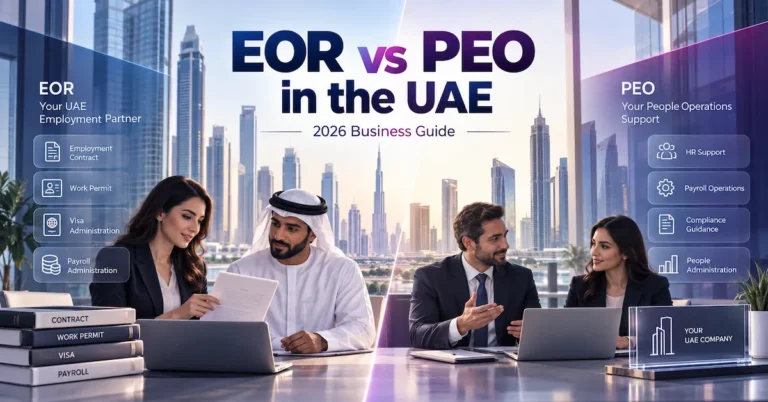
Business owners often use “EOR” and “PEO” interchangeably, but the two models are structurally different.
| Factor | Employer of Record (EOR) | Professional Employer Organisation (PEO) | Own Legal Entity |
|---|---|---|---|
| Legal employer | The EOR | Co-employment (you and the PEO share responsibility) | You |
| Local entity required | No | Usually yes, for a PEO arrangement to apply | Yes |
| Setup time | Days | Weeks (entity often still needed) | Weeks to months |
| Visa sponsorship | Handled by the EOR | Depends on your own entity | Your responsibility |
| Compliance liability | Sits mainly with the EOR | Shared | Entirely yours |
| Best for | Market entry, small teams, testing new markets | Established companies with an existing local entity | Long-term, large-scale operations |
A PEO arrangement generally assumes you already hold a local trade licence and simply want help with HR administration. An EOR is built for exactly the opposite situation: you don’t have, and may not yet want, a local entity.
4. Why Businesses Use EOR Services in the UAE
The UAE remains one of the most attractive hiring destinations in the region, but it’s also one of the most procedurally demanding. Every foreign hire needs an employer-sponsored work permit and residence visa, and wages must run through the Wage Protection System (WPS). Setting up a mainland LLC or free zone entity to support this typically takes several weeks, plus additional time for MOHRE registration and visa quota approval.
Companies turn to EOR services in the UAE for a few consistent reasons:
- Speed to market. Employees can often be onboarded within 5 to 10 working days instead of the months it can take to incorporate and register a new entity.
- No trade licence required. You skip the cost and administrative load of setting up and maintaining a mainland or free zone company.
- Full compliance coverage. The EOR manages MOHRE contract registration, WPS payroll, gratuity accruals, and visa renewals on your behalf.
- Lower risk while testing a market. If you’re unsure whether the UAE is a long-term base for you, an EOR lets you build a small team without a multi-year entity commitment.
- Access to Emiratisation-compliant structures. A well-run EOR tracks quota obligations at the entity level so client companies aren’t caught off guard by new requirements.
5. UAE Labour Law and Compliance Essentials for EOR
Private sector employment in the UAE is governed by Federal Decree-Law No. 33 of 2021 (the UAE Labour Law), enforced by the Ministry of Human Resources and Emiratisation (MOHRE). It sets minimum standards for contracts, working hours, leave, and end-of-service benefits, and applies to UAE nationals and expatriates alike, though government employees, armed forces, and domestic workers fall outside its scope.
A few structural points matter for anyone hiring through an EOR:
- Mainland vs free zone vs DIFC/ADGM. Mainland and most free zone employment follow the federal Labour Law. The Dubai International Financial Centre (DIFC) and Abu Dhabi Global Market (ADGM) run their own separate employment regulations, which affect how an EOR structures certain roles.
- Fixed-term contracts only. All employment contracts must be fixed-term and registered with MOHRE.
- Wage Protection System (WPS). Salaries must be paid through WPS, and wages are considered late if not paid within 15 days of the contractual due date.
- No universal minimum wage for expatriates. There is no blanket minimum wage for expatriate employees, though MOHRE publishes salary guidance linked to education level for visa eligibility purposes.
- End-of-service gratuity. Expatriate employees accrue gratuity, generally calculated at 21 days’ basic salary per year for the first five years of service, rising to 30 days per year after that, subject to the specific contract terms.
- No personal income tax. The UAE continues to apply 0% personal income tax, which keeps net compensation attractive for both employer and employee.
Because these rules are updated periodically, always confirm current requirements directly with MOHRE or the relevant free zone authority before finalising a contract structure.
6. Emiratisation and What It Means for Foreign Employers
Emiratisation is the UAE’s workforce nationalisation strategy, and it’s become one of the most consequential compliance areas for companies hiring through an EOR.
Private sector companies with 50 or more employees are required to increase their Emirati workforce by 2% annually, working toward higher Emirati representation across designated economic sectors including banking and financial services. Separately, a minimum wage for Emirati private-sector employees came into effect in 2026, with a transition period for existing employers to adjust salaries before non-compliance penalties, including restrictions on new work permits, take effect.
For most SMEs and foreign companies entering the UAE through an EOR, Emiratisation obligations are tracked and managed at the EOR’s entity level rather than falling directly on the client company, which is one of the more overlooked practical advantages of the model. Still, it’s worth asking any EOR provider directly how they manage quota compliance and whether it could affect your ability to scale headcount in the UAE over time.
7. EOR Services Across the GCC
The GCC is not one labour market. Each country runs its own labour law, its own nationalisation policy, and its own visa and social security system. A regional EOR partner needs working knowledge of all six.
Saudi Arabia
Saudi employment is governed by the Saudi Labour Law, with contracts authenticated through the Qiwa platform and wages routed through Mudad, the kingdom’s wage protection system. The General Organization for Social Insurance (GOSI) requires monthly employer contributions, with rates that vary depending on whether the employee falls under the pre- or post-2024 reform system, and separate treatment for Saudi nationals versus expatriates.
Saudisation, enforced through the Nitaqat programme, sets nationalisation bands by sector and company size, and directly affects an employer’s ability to secure visas for new expatriate hires. End-of-service awards are calculated under Article 84 of the Labour Law, generally at half a month’s wage per year of service for the first five years and a full month per year after that.
Setting up a wholly foreign-owned entity in Saudi Arabia can take a year or more depending on the business activity, which makes EOR a particularly practical route for companies testing the market or hiring a small initial team before committing to full incorporation.
Qatar
Qatar’s labour framework requires every foreign employee to hold both a work permit and a residence permit, with the employer acting as sponsor. An EOR manages this sponsorship on the client company’s behalf, along with contract registration with the Ministry of Labour and wage payments through Qatar’s wage protection system.
Qatari nationals must be registered for social insurance from day one of employment, currently structured around contribution requirements administered under Qatar’s social insurance framework. End-of-service gratuity is generally calculated at three weeks’ salary per year of service. Qatarisation, formalised through legislation in late 2023, is still developing its detailed sector quotas and penalty structure, so ongoing monitoring of Ministry of Labour guidance is essential for employers operating there.
Oman
Oman’s labour relationship is governed by Royal Decree No. 35/2003 and its amendments, enforced by the Ministry of Labour. Standard working hours run to 45 per week, reduced during Ramadan, and annual leave sits at 30 days after six months of service. End-of-service gratuity accrues at one month’s basic wage per year after three years of continuous service.
Omanisation quotas are sector-specific, with some sectors such as banking requiring very high proportions of Omani nationals, and directly affect an employer’s ability to obtain expatriate work permits. Recent reforms have also introduced fee incentives, reducing costs for compliant employers and increasing them for non-compliant ones, alongside a newer requirement for foreign-owned companies to hire at least one Omani national within their first year of operations.
Bahrain
Bahrain operates one of the more flexible labour markets in the GCC, having moved away from the traditional kafala sponsorship structure and toward a system managed through the Labour Market Regulatory Authority (LMRA). Bahrainisation quotas are generally lower than elsewhere in the GCC, and the country has built a reputation as the most business-friendly Gulf market for localisation compliance.
From 2026, Bahrain has mandated an Enhanced Wage Protection System requiring wage files to be pre-validated by licensed banks or payment service providers before salaries can be transferred, a meaningful shift from the previous post-payment reporting model. Every employment relationship must be documented in a written Arabic-language contract.
Kuwait
Kuwait maintains a more traditional sponsorship-based system, with Kuwaitisation quotas set by sector and periodically increased. End-of-service indemnity is generally calculated at 15 days’ wage per year of service for the first five years, rising to one month’s wage per year of service beyond that. Employers should expect continued tightening of localisation targets, particularly in sectors with historically high expatriate concentration.
GCC EOR Snapshot
| Country | Nationalisation Policy | Gratuity/EOSB | Wage Protection | Typical EOR Onboarding |
|---|---|---|---|---|
| UAE | Emiratisation | 21 days/yr (first 5 yrs), 30 days/yr after | WPS | 5–10 working days |
| Saudi Arabia | Saudisation (Nitaqat) | Half-month/yr (first 5 yrs), 1 month/yr after | Mudad | 2–4 weeks |
| Qatar | Qatarisation | ~3 weeks’ salary/yr | Wage Protection System | 4–8 weeks |
| Oman | Omanisation | 1 month/yr after 3 yrs | Ministry of Labour system | 3–6 weeks |
| Bahrain | Bahrainisation | Statutory indemnity by service length | Enhanced WPS (2026) | 2–4 weeks |
| Kuwait | Kuwaitisation | 15 days/yr (first 5 yrs), 1 month/yr after | Wage protection system | 3–5 weeks |
Figures are indicative and subject to change. Always confirm current rates and timelines with your EOR provider and the relevant government authority before finalising an offer.
8. Employer of Record for Global Hiring
The same underlying model extends well beyond the Gulf. A global EOR network gives businesses a way to hire compliant employees across dozens of countries through a single relationship, rather than negotiating separate agreements market by market.
This matters most for three types of businesses:
- UAE and GCC-based companies expanding outward into Europe, Asia, or North America, who want to hire remote talent without opening entities everywhere they find good candidates.
- International companies expanding into the UAE and GCC, using EOR as their entry point before deciding whether a permanent local entity is worth the investment.
- Distributed teams who need consistent contract standards, payroll timing, and benefits administration across multiple countries at once.
A capable EOR partner should be able to tell you, country by country, what statutory benefits apply, how termination notice periods work, what the tax withholding obligations are, and how long onboarding realistically takes; not just confirm that “we cover that country” without specifics.
9. Benefits of Using an EOR
- Faster market entry. Hire in days or weeks rather than the months an entity setup typically requires.
- Reduced compliance risk. The EOR carries the legal weight of local labour law, visa, and payroll compliance.
- Lower upfront cost. No trade licence, no minimum share capital, no office lease tied to entity registration requirements.
- Scalable testing. Build a small team to validate a market before committing to a permanent entity.
- Access to local expertise. A good EOR understands nuances like Emiratisation quota timing or GOSI contribution tiers that most foreign HR teams simply don’t track day-to-day.
- Simplified offboarding. End-of-service settlements, gratuity calculations, and visa cancellations are handled correctly the first time.
- Consistent global payroll experience. Employees are paid on time, in the right currency, with the right statutory deductions, regardless of jurisdiction.
10. Challenges and Risks of the EOR Model
EOR is not without trade-offs, and a transparent provider will be upfront about them.
- Less direct control over statutory structuring. Because the EOR is the legal employer, certain HR policy decisions have to align with what the EOR’s entity can support.
- Cost at scale. Per-employee EOR fees can become more expensive than running your own entity once headcount grows past a certain threshold, often somewhere between 5 and 15 employees per country in the GCC, depending on the market.
- Provider quality varies widely. Not every EOR actually owns a licensed local entity; some resell through partner networks, which can create accountability gaps if something goes wrong with a visa or payroll run.
- Free zone vs mainland mismatches. An employee sponsored through a free zone entity may not be legally able to work on mainland-facing activities, a detail that trips up more companies than it should.
- Regulatory change. Nationalisation quotas, minimum wage rules, and wage protection requirements shift regularly across the GCC, and providers need active monitoring systems, not static onboarding documents.
11. How Much Does an EOR Cost in the UAE and GCC?
EOR pricing in the region typically follows one of two models: a flat monthly fee per employee, or a percentage of the employee’s gross salary.
In the UAE, EOR fees often run higher than in many other markets due to visa processing and sponsorship costs layered on top of the service fee. Beyond the EOR’s own fee, employers should budget for:
- Visa and Emirates ID processing costs
- Medical insurance (mandatory in the UAE and most GCC countries)
- End-of-service gratuity accrual, which is a real deferred liability even though it isn’t paid monthly
- GPSSA contributions for any UAE or GCC national employees
- Any Emiratisation, Saudisation, or equivalent localisation-linked costs at entity level
Total employer costs in the UAE, excluding visa fees, tend to sit somewhere around 8–15% above base salary, largely because the UAE has no employer social security burden for expatriate staff, unlike Saudi Arabia’s GOSI contributions or Qatar’s social insurance requirements for nationals. Combuzz can provide a tailored cost breakdown once we understand your headcount, role seniority, and target country, since generic percentage figures rarely hold up against a real hiring plan.
12. Case Scenarios: When EOR Makes Sense
Scenario 1: A European SaaS company testing the UAE market. A 40-person software company wants to hire two sales staff in Dubai to gauge regional demand before deciding whether to open a full entity. An EOR lets them onboard both hires within two weeks, fully MOHRE-compliant, without any trade licence commitment.
Scenario 2: A Saudi manufacturer hiring specialist expatriate engineers. A Riyadh-based manufacturer needs three specialised engineers who aren’t available locally. Rather than navigating Iqama sponsorship and Nitaqat classification alone, they use an EOR that already holds Saudisation-compliant registration and manages GOSI and Mudad payroll on their behalf.
Scenario 3: A UAE company expanding a remote team into the UK and India. A Dubai-based company hiring developers in London and Bangalore uses a single global EOR relationship to keep contract terms, payroll timing, and compliance standards consistent across both markets, without opening two separate foreign entities.
Scenario 4: A regional retailer scaling past the EOR breakeven point. After growing to 18 employees in Qatar, a retail brand transitions from EOR to its own registered entity, since the ongoing per-head EOR fees have become more expensive than running payroll and compliance in-house.
13. Common Mistakes Businesses Make with EOR
- Assuming EOR removes all compliance responsibility. You’re no longer the legal employer, but you’re still accountable for how you direct the employee’s work and for any misclassification risk if the arrangement isn’t genuinely structured as employment.
- Choosing a provider on price alone. The cheapest EOR is often the one reselling through a partner network with the least direct accountability for visa or payroll errors.
- Ignoring free zone vs mainland distinctions. Hiring someone through a free zone EOR entity to do mainland-facing work can create real legal exposure.
- Underestimating nationalisation quota exposure. Emiratisation, Saudisation, and similar policies affect visa approval speed even when you’re using an EOR, not just companies with their own entities.
- Not clarifying the EOR-to-entity transition plan. Businesses that grow quickly need to know, in advance, how and when they’ll hand off employees to a future entity of their own.
- Overlooking end-of-service liabilities. Gratuity is a deferred cost. Businesses sometimes treat monthly payroll as the full cost of employment and are caught off guard at termination.
14. How to Choose the Right EOR Partner
A few questions separate a genuinely capable EOR from one that simply markets itself as one:
- Does the provider own its own licensed entities, or resell through partners? Owned entities generally mean tighter accountability and faster problem resolution.
- Can they explain nationalisation compliance in specific terms? A provider that can’t give a concrete answer on Emiratisation quotas or Saudisation banding hasn’t done the homework.
- What’s their onboarding timeline, realistically? Ask for a country-specific answer, not a generic “days to weeks.”
- How do they handle disputes, terminations, and end-of-service settlements? This is where compliance gaps usually surface first.
- Do they offer a clear transition path to your own entity later? Growth-stage companies need this mapped out from day one, not improvised later.
- Do they combine EOR with wider HR and workforce support? Recruitment, payroll management, HR outsourcing, and corporate PRO services under one roof reduce the number of vendors you need to manage as you scale.
This is exactly where Combuzz HR Solutions fits. As a MOHRE-licensed HR services company operating across the UAE and GCC, Combuzz combines Employer of Record with Recruitment Services, Contract Staffing, Corporate PRO Services, and HR Outsourcing, so businesses aren’t stitching together separate vendors for hiring, visas, payroll, and compliance.
15. Industry Insights and What’s Changing in 2026
A few regional shifts are worth tracking if you’re hiring through an EOR this year:
- UAE Emirati minimum wage. A minimum wage for Emirati private-sector employees took effect in 2026, with a transition window for existing employers and new restrictions on work permits for non-compliant establishments after the deadline passes.
- Saudi Arabia’s Qiwa-linked Nitaqat methodology. Saudisation calculations are increasingly tied to contracts electronically documented through Qiwa, making accurate contract registration a direct compliance requirement rather than administrative housekeeping.
- Bahrain’s Enhanced Wage Protection System. Bahrain has moved to a pre-validation payroll model in 2026, meaning wage files must be approved before transfers execute, not just reported afterward.
- Oman’s foreign-owned company nationalisation rule. New requirements mandate that foreign-owned companies hire at least one Omani national within their first year of operations.
- Qatar’s evolving Qatarisation framework. Formal legislation exists, but detailed sector quotas and penalty structures are still being developed, so this is an area to watch closely through the rest of 2026.
Because these rules move quickly, always verify current requirements against official government sources, and treat any statutory figures quoted in this guide as indicative rather than final.
16. Frequently Asked Questions
1. What is the difference between an Employer of Record and a staffing agency? A staffing agency typically sources and places candidates, often temporarily, while the client or the agency manages employment terms loosely. An Employer of Record becomes the full legal employer, handling the employment contract, payroll, visa sponsorship, statutory benefits, and compliance obligations under local labour law. The distinction matters most in the UAE and GCC, where visa sponsorship and MOHRE-registered contracts are non-negotiable requirements, not optional extras a staffing agency can skip.
2. Do I need a trade licence to hire employees in the UAE through an EOR? No. That’s the core advantage of the EOR model. The EOR already holds the required trade licence and MOHRE registration, so you can hire and onboard staff in the UAE without setting up your own mainland or free zone entity. You retain full operational control over the employee’s work while the EOR manages the legal employment relationship.
3. Is an Employer of Record legal in the UAE? Yes. EOR arrangements are legal in the UAE provided the EOR holds a valid trade licence and registers each employment contract with MOHRE or the relevant free zone authority. The structure is widely used by international companies entering the UAE market and is recognised across mainland and most free zone jurisdictions, though DIFC and ADGM have their own specific employment regulations to account for.
4. How long does it take to hire someone in the UAE through an EOR? Most UAE EOR onboarding takes between 5 and 10 working days from signed offer to work permit issuance, assuming complete documentation. Timelines can extend if the employee needs to convert from a different visa status, or if additional attestations are required for their qualifications, depending on role and nationality.
5. What does an EOR cost in the UAE compared to setting up my own company? EOR fees in the UAE are typically charged as a flat monthly amount per employee or a percentage of gross salary, often running higher than in other regions due to visa processing costs layered in. Setting up your own entity carries higher upfront costs and slower time to first hire, but usually becomes more cost-effective once headcount grows into double digits in a single country.
6. Can an EOR help with Emiratisation compliance? Yes, though the way it works differs from running your own entity. Nationalisation quotas are generally tracked and managed at the EOR’s entity level, which can simplify compliance for smaller client headcounts. It’s still worth asking your EOR directly how they manage Emiratisation reporting and whether it could affect your growth plans in the UAE over time.
7. What happens to my employees if I later want to set up my own UAE entity? A well-structured EOR relationship includes a transition plan for exactly this scenario. Once you incorporate your own entity, employees can typically be transferred from the EOR’s sponsorship to your own MOHRE file, with visa cancellation and reissuance handled as part of the process. This should be discussed with your EOR provider before you sign your initial agreement, not after.
8. Is EOR available across all GCC countries? Yes, though the regulatory detail differs meaningfully by country. Saudi Arabia’s Nitaqat system, Qatar’s developing Qatarisation framework, Oman’s sector-specific Omanisation quotas, Bahrain’s more flexible LMRA-based system, and Kuwait’s Kuwaitisation targets each require distinct compliance handling. A regional EOR partner needs working expertise in all six markets, not just the UAE.
9. What is end-of-service gratuity, and does the EOR handle it? End-of-service gratuity, or EOSB, is a statutory lump-sum payment owed to eligible employees based on length of service and last basic salary, calculated differently in each GCC country. A reputable EOR accrues this liability monthly rather than treating it as a surprise cost at termination, and manages the final calculation and payment when an employee exits.
10. Can foreign companies use an EOR to test the UAE market before committing to a full entity? Yes, this is one of the most common use cases. Businesses often use an EOR to hire an initial small team, evaluate demand, build local relationships, and confirm the UAE is the right long-term base before investing in a mainland or free zone entity. It significantly lowers the financial risk of market entry.
11. Does the UAE have a minimum wage for expatriate employees? No. There is currently no universal statutory minimum wage for expatriates in the UAE, though MOHRE publishes salary benchmarks tied to education level for visa eligibility purposes. A minimum wage requirement does apply to Emirati private-sector employees as part of the Emiratisation strategy.
12. What is the difference between mainland and free zone EOR arrangements in the UAE? Mainland employment follows the federal UAE Labour Law and allows employees to work across the UAE market broadly. Free zone employment is tied to the specific free zone’s regulations and generally restricts the employee’s work to activities permitted within that zone or with mainland clients under specific conditions. Choosing the wrong structure for the actual work being done is one of the most common EOR mistakes businesses make.
13. How does Wage Protection System (WPS) compliance work with an EOR? WPS requires salaries to be paid through approved banking channels within a set timeframe of the contractual due date, with the system monitored by MOHRE. An EOR processes payroll through WPS as part of its standard service, removing the administrative burden of registering and maintaining WPS compliance yourself.
14. Can an EOR sponsor family visas for employees in the UAE? Sponsorship rules for dependants depend on the employee’s salary level and the specific visa category they hold, and this varies by emirate and by whether the role sits within a mainland or free zone structure. It’s worth confirming dependant sponsorship eligibility directly with your EOR provider as part of the offer discussion, since it can influence a candidate’s decision to accept a role.
15. Why should I use a UAE-based EOR provider instead of a global platform? A UAE and GCC-based provider typically brings deeper, more current knowledge of Emiratisation timelines, MOHRE procedural changes, and free zone nuances than a global platform managing dozens of unrelated markets at once. For companies whose primary hiring need is concentrated in the UAE and GCC, that regional depth often translates into fewer visa delays and fewer compliance surprises.
17. Final Thoughts
Hiring in the UAE and GCC doesn’t have to mean choosing between moving slowly through entity setup or taking on compliance risk you’re not equipped to manage. An Employer of Record gives you a legitimate, MOHRE-compliant way to build a team quickly, test a market with real people rather than assumptions, and keep your focus on the work that actually grows your business.
The model works best when the provider behind it actually understands the region, not just the paperwork. Combuzz HR Solutions has spent years working inside the UAE and the GCC on labour law, visa processing, and workforce compliance, and that’s the difference between an EOR relationship that quietly works and one that creates problems six months in.
Ready to hire in the UAE or GCC without setting up a local entity? Talk to a Combuzz HR specialist to scope your hiring plan, or request a proposal for Employer of Record services tailored to your headcount and target markets. You can also explore our full range of Workforce Solutions or read more on our HR insights blog.