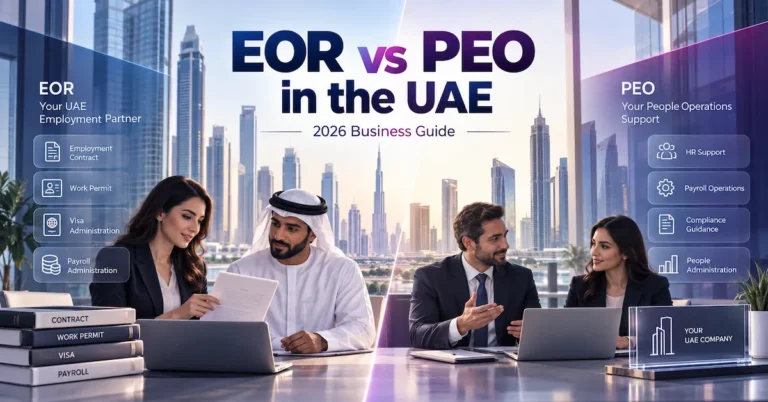

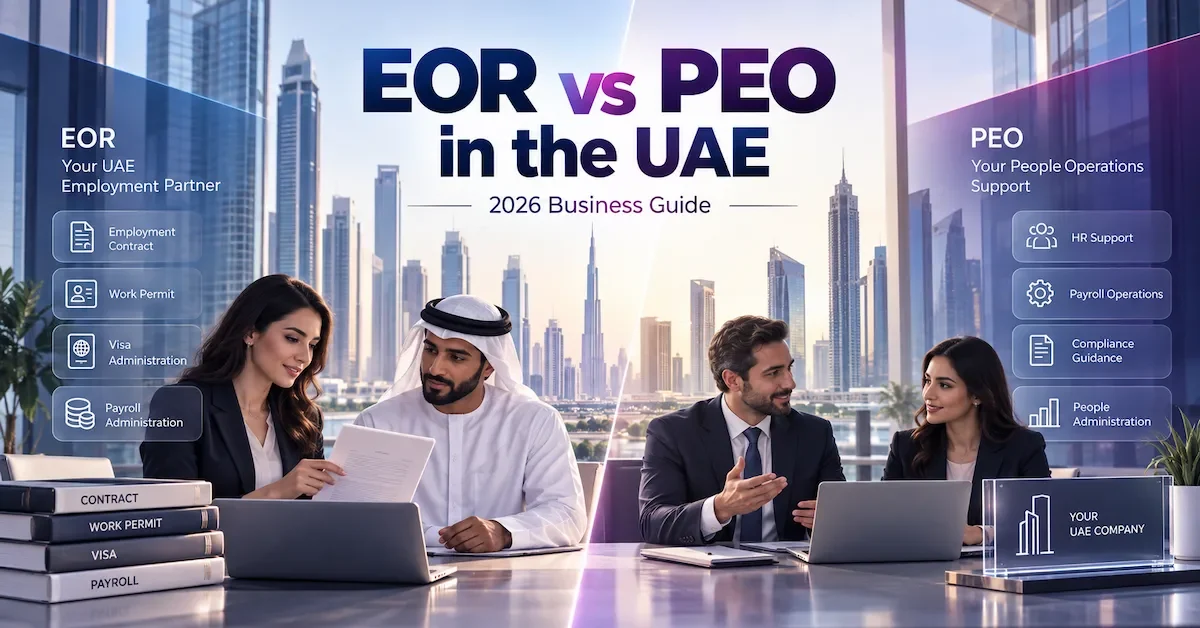
An overseas company wants to hire its first Dubai-based sales manager. A UAE business with 80 employees wants payroll and HR administration support. Both may search for an EOR or PEO, but they do not need the same solution.
The confusion starts with the labels. Employer of Record (EOR) and Professional Employer Organisation (PEO) are often presented as two universal legal models. In the UAE, the position is more specific. The law regulates employers, work permits and licensed recruitment, temporary employment and outsourcing activity. It does not create separate statutory categories called “EOR” and “PEO”.
That means the provider’s marketing term is not enough. A buyer must establish who will be the worker’s registered employer, whose establishment sponsors the work permit, which entity pays wages through the Wage Protection System (WPS), what licence the provider holds and which responsibilities remain with the client.
This guide compares EOR and PEO services in the UAE through that practical lens. It will help you decide whether you need an employment solution, HR administration support or your own UAE entity—and what to verify before signing.
Important: This article provides general business information, not legal advice. UAE employment and immigration requirements can change and may differ across mainland jurisdictions, free zones, the Dubai International Financial Centre (DIFC) and Abu Dhabi Global Market (ADGM). Confirm your proposed structure with the relevant authority and a qualified adviser.
Table of contents
- EOR vs PEO in the UAE: the short answer
- What is an EOR in the UAE?
- What does PEO mean in the UAE?
- Why the UAE legal context matters
- EOR vs PEO comparison
- When an EOR may be suitable
- When PEO-style support may be suitable
- EOR, PEO or your own entity?
- Costs and commercial terms
- How to evaluate a provider
- Common mistakes
- Frequently asked questions
EOR vs PEO in the UAE: the short answer
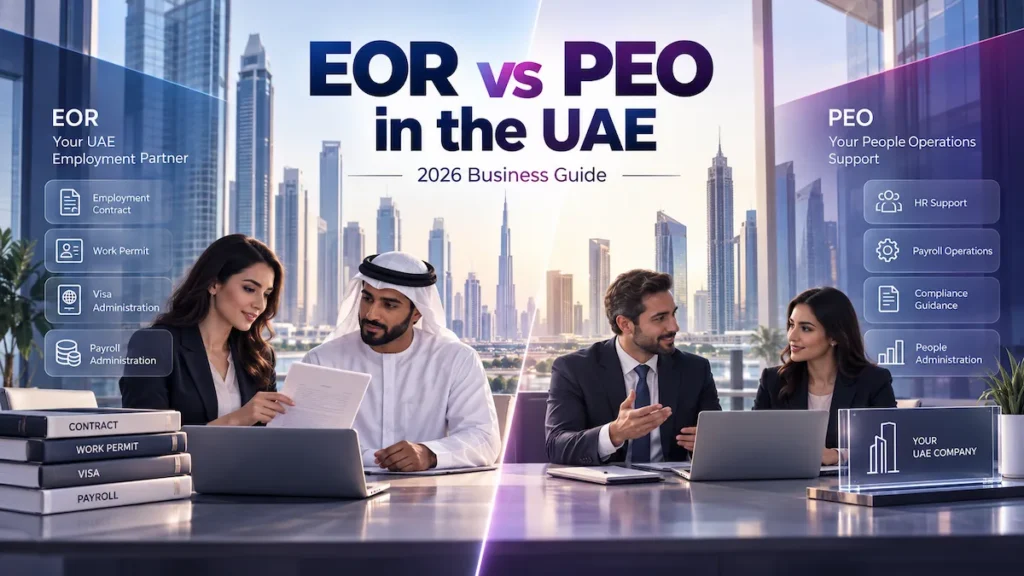
An EOR arrangement generally means a licensed UAE provider employs and registers the worker through its own entity while the client directs the worker’s day-to-day business activities under a service agreement.
A PEO arrangement is commonly marketed as HR, payroll, benefits and compliance administration for a company that already has a UAE entity. The client usually remains the registered employer and work-permit sponsor. Although providers often describe this as “co-employment”, buyers should not assume that the US concept of co-employment maps directly onto UAE law.
The quickest initial test is:
- No UAE entity and a genuine need for locally deployed employees: assess a properly licensed EOR or workforce-outsourcing structure.
- Existing UAE entity that will employ and sponsor its own workers: assess payroll, HR outsourcing or PEO-style administration.
- Permanent UAE operations, regulated activities or a growing strategic team: compare both options with direct employment through your own entity.
What is an EOR in the UAE?
Employer of Record is a commercial term for a structure in which a local provider is the formal employer of a worker assigned to support a client. In a correctly structured UAE arrangement, the provider’s entity appears on the employment documentation and handles agreed employer administration.
Depending on the contract, licence and jurisdiction, services may include:
- employment documentation and onboarding;
- work-permit and residence-visa administration for eligible foreign nationals;
- WPS payroll processing where applicable;
- statutory leave and employment-record administration;
- medical insurance coordination where required;
- end-of-service benefit calculations and accrual support; and
- final settlement, work-permit cancellation and offboarding.
The client normally manages the worker’s role, priorities, output and workplace integration. This does not mean the client has no responsibilities. UAE rules governing temporary employment and outsourcing allocate duties to both the agency and the beneficiary. Workplace safety, appropriate supervision, accurate time and attendance information, lawful instructions and cooperation with the legal employer can remain material client obligations.
Combuzz describes its Employer of Record services in the UAE as an option for businesses that want employment, visa and payroll support without first establishing a local entity. Suitability still depends on the role, proposed activities, work location, duration and applicable authority.
A typical EOR workflow
- Scope the role. Confirm duties, location, reporting line, salary, benefits, duration and whether the activity can be delivered through the proposed structure.
- Verify the provider. Review the provider’s legal entity, licence, establishment registration and authority to supply or outsource workers.
- Agree the commercial model. Define deposits, employment costs, service fees, variable charges, insurance, termination terms and client responsibilities.
- Issue compliant documents. The provider prepares the employment and service documentation and obtains the required approvals.
- Complete work-permit and visa processes. Requirements depend on the worker’s nationality, residence status, jurisdiction and work location.
- Run payroll and employment administration. The provider processes agreed employer obligations while the client supplies approved payroll inputs and manages daily work.
- Manage change or exit. Promotions, salary changes, relocation, termination and transfer to the client’s entity should follow an agreed process.
Avoid guaranteed onboarding claims. Timelines depend on documentation, quota availability, immigration status, medical testing, authority approvals and other case-specific factors.
What does PEO mean in the UAE?
Professional Employer Organisation is widely used internationally to describe a provider that shares or administers employer functions. In the UAE market, however, “PEO” may refer to several different services:
- outsourced payroll under the client’s employer registration;
- HR administration and employee helpdesk support;
- benefits or insurance coordination;
- employment-document support;
- compliance calendars and HR policy support; or
- a workforce-outsourcing arrangement that is operationally closer to an EOR.
This variation matters. A provider calling itself a PEO does not, by that label alone, become the legal co-employer or visa sponsor. If your UAE entity appears on the employment contract and work permit, your entity generally remains the registered employer. The service agreement can allocate administrative tasks, but it cannot erase statutory obligations imposed on the employer.
For an established business, PEO-style support can still be valuable. It can provide payroll capacity, standard processes and specialist support while employees remain connected to the company’s own entity and employer brand. Combuzz’s HR advisory and payroll services are the more relevant route when a company wants administrative support rather than a third party to employ its workforce.
Why the UAE legal context matters
The core federal framework for most mainland private-sector employment is Federal Decree-Law No. 33 of 2021, as amended, supported by Cabinet Resolution No. 1 of 2022. The framework requires the appropriate work permit and regulates recruitment, temporary employment and outsourcing agencies.
The practical consequences are important:
1. The registered relationship matters more than the label
The name on the work permit and employment records is central to determining the formal employer. A service agreement between two companies can allocate work and commercial risk, but it does not automatically create a separate statutory “co-employer” category.
2. The provider needs the right authority for the activity
A general trade licence is not automatically permission to recruit, temporarily employ or outsource workers. Ask the provider to identify the exact licensed entity and activity that support the proposed service.
3. The client does not transfer every risk
An EOR can take responsibility for defined employer administration, yet the client still controls important facts: the real job, worksite, schedule inputs, supervision and workplace conduct. Contracts should allocate responsibilities clearly rather than promise that one party “absorbs all compliance risk”.
4. Mainland and free-zone rules are not interchangeable
The UAE has multiple employment jurisdictions. Many free zones have their own registration processes, employment contracts and work-location rules. DIFC and ADGM have distinct employment laws. A provider’s mainland capability should not be assumed to cover every free zone or regulated location.
5. WPS responsibility must be explicit
MOHRE-registered employers within scope must pay wages through the Wage Protection System. The agreement should identify who submits payroll, approves variable pay, funds the payroll account, corrects errors and responds to late or rejected payments.
EOR vs PEO comparison
| Decision factor | EOR-style arrangement | PEO-style HR outsourcing |
|---|---|---|
| Client’s UAE entity | Often not required for the employment arrangement, subject to the proposed activities | Normally required because the client employs the workers |
| Registered employer | Provider’s licensed UAE entity | Usually the client’s UAE entity |
| Work permit/visa sponsor | Usually the provider, where applicable and permitted | Usually the client |
| Employment contract | Issued by the provider | Issued by the client |
| Daily work direction | Client, within agreed scope | Client |
| Payroll administration | Provider processes payroll as employer | Provider may process payroll for the client |
| Statutory employer duties | Provider carries duties attached to the registered employer; client retains relevant beneficiary and workplace duties | Client remains responsible as employer even when administration is outsourced |
| Employer branding | Provider is shown as formal employer | Client remains visible as employer |
| Best fit | Market testing, defined projects, early local hiring or workforce flexibility | Established UAE entities needing payroll and HR operating support |
| Main due-diligence issue | Licence, work location, service scope and division of agency/beneficiary duties | Exact service scope, data controls, approvals and retained employer liability |
| Exit | Offboarding or transfer must follow the provider’s and authority’s processes | Employment remains with client; service-provider transition should be planned |
When an EOR may be suitable
You are making early UAE hires without an entity
An EOR may remove the need to create an employing entity before the first eligible hire. It does not necessarily authorise the foreign company to conduct every commercial activity in the UAE. Tax, corporate-presence, licensing and permanent-establishment questions require separate advice.
You are testing demand before committing to a permanent structure
A defined pilot team can help a business test customer demand, operating requirements and talent availability. Set decision dates for continuing with EOR, establishing an entity or exiting; otherwise, a temporary structure can become an expensive default.
You need a project workforce
Construction, engineering, events, hospitality, logistics and technology projects may need skills for a defined period. In such cases, contract staffing in the UAE may be more precise than using EOR as a broad label.
You need consolidated administration
Companies managing a small distributed team may value one accountable workflow for onboarding, employment documents, payroll inputs and employee queries. Governance still matters: the client should retain an internal owner for approvals and workforce decisions.
When PEO-style support may be suitable
Your UAE entity already employs the team
If your entity has the relevant licence, establishment registration and work-permit capacity, replacing it as employer may add unnecessary complexity. Outsourced payroll and HR administration can address the operational problem while preserving direct employment.
Employer identity is strategically important
Direct employment can support employer branding, senior-hire confidence and long-term workforce planning. Employees receive contracts and employment records from the business they work for, while an external team supports administration.
You want process capability, not an alternative employing entity
A growing HR team may need payroll controls, HR policies, leave administration or an employee helpdesk. Define the required outputs and service levels rather than buying an unclear “PEO package”.
Your workforce is stable and long term
For a permanent operation, direct employment plus specialised outsourcing may offer clearer governance. The economics should be tested through a total-cost model, not an assumed employee-count threshold.
EOR, PEO or your own entity?
Use this decision framework before requesting quotations.
| Your situation | Model to assess first | Why |
|---|---|---|
| No UAE entity; one to several eligible hires for a market test | Licensed EOR/workforce outsourcing | Provides a possible local employment route without first creating an employing entity |
| Existing UAE entity; payroll team lacks capacity | Payroll and HR outsourcing | Solves administration while the client remains employer |
| Fixed-duration project requiring sourced and managed workers | Contract staffing | Aligns recruitment and workforce deployment to a defined assignment |
| Large, permanent strategic operation | Own entity plus in-house or outsourced HR | Supports direct control, employer identity and long-term governance |
| Candidate identified but entity setup is under way | Time-limited EOR with a transfer plan | Can bridge the period if the role and structure are permitted |
| Need help finding candidates only | Recruitment services | Recruitment does not require changing the employing entity |
Composite scenario 1: market entry
Hypothetical example: A European software company wants two UAE-based business-development employees before deciding whether to establish a subsidiary. It compares a licensed EOR arrangement with entity setup. The review covers permitted activities, client-facing authority, work location, payroll funding, data access and a possible transfer after 12 months. The decision is based on risk and operating plans, not just monthly fees.
Composite scenario 2: established UAE employer
Hypothetical example: A Dubai company employs 90 people and struggles with payroll cut-offs, employee queries and inconsistent HR records. Because it already has the employing entity and wants employees to remain under its brand, it outsources payroll administration and HR operations instead of moving employees to an EOR.
Costs and commercial terms
There is no reliable universal UAE price range for either model. Cost depends on salary, benefits, insurance, visa status, work location, role, contract duration, volume, provider risk and included services. Public headline fees rarely show the full cash requirement.
Build a total-cost comparison with these lines:
- salary and fixed allowances;
- variable pay and overtime assumptions;
- medical insurance and other benefits;
- work-permit, visa, medical and Emirates ID costs where applicable;
- end-of-service benefit accrual or alternative scheme contributions;
- recruitment fee, if candidate sourcing is included;
- monthly provider fee;
- onboarding, amendment, renewal and offboarding charges;
- refundable deposits or payroll prefunding;
- foreign-exchange and bank charges;
- leave, absence and replacement terms;
- early termination exposure; and
- entity setup and annual maintenance costs for the direct-employment option.
Ask each provider to quote against the same employee profile and assumptions. Compare cash timing as well as annual cost. A lower service fee can be outweighed by deposits, mark-ups, exclusions or restrictive exit terms.
Emiratisation and workforce outsourcing
Do not treat EOR or outsourcing as a simple way to avoid Emiratisation obligations. The UAE applies Emiratisation requirements to in-scope private-sector establishments, and the rules have expanded over time. The official UAE portal explains current requirements for establishments with 50 or more employees and selected establishments with 20–49 employees.
Whether a worker is recorded against a particular establishment depends on the formal employment and registration structure. Before implementation, confirm how the proposed arrangement affects your establishment’s headcount, targets, skilled-worker calculations and reporting. Combuzz can support Emirati talent acquisition, but the company should obtain authority-specific advice on its quota position.
How to evaluate an EOR or PEO provider in the UAE
1. Verify the contracting and employing entities
Obtain the legal names, licence details and establishment registrations. Confirm whether the contracting entity and employing entity are the same. If subcontractors or partners are involved, identify them before employees are onboarded.
2. Ask the provider to map the legal structure
Request a one-page diagram showing:
- who signs the employment contract;
- who sponsors the work permit and residence visa;
- who pays salary through WPS;
- who provides insurance;
- who supervises daily work;
- who handles employee complaints; and
- which authority governs the arrangement.
3. Review the real scope of work
Disclose the employee’s actual duties, client contact, authority to sign, worksite and travel. A structure suitable for a remote analyst may not suit a regulated professional, site-based worker or person representing a foreign company commercially.
4. Test payroll and funding controls
Ask for payroll calendars, approval cut-offs, maker-checker controls, error-correction procedures, data-security measures and continuity plans. Clarify what happens if the client funds payroll late.
5. Examine employee experience
Review offer-letter accuracy, onboarding communication, payslips, leave processes, escalation channels and final settlements. Employees should understand who employs them and where to raise an issue.
6. Negotiate the exit before entry
Document notice, termination calculations, visa cancellation, equipment return, data export and transfer to a future client entity. Confirm which costs apply and what happens if a transfer is delayed or rejected.
7. Obtain specialist review where needed
Legal, tax, data-protection, immigration and sector-licensing issues can sit outside the provider’s service. Use appropriate advisers for high-risk roles, regulated activities or permanent UAE operations.
Common mistakes
- Assuming “PEO” has one fixed UAE meaning. Ask what the provider will legally and operationally do.
- Believing an EOR removes every client obligation. The client’s supervision, workplace and information can still create duties and risk.
- Buying on monthly fee alone. Compare deposits, statutory costs, exit charges and cash timing.
- Ignoring the employee’s work location. Mainland, free-zone, DIFC and ADGM arrangements can differ.
- Using an employment solution as a substitute for business licensing advice. Employing a person and lawfully conducting an activity are separate questions.
- Promising a start date before approvals. Build contingency into recruitment and project plans.
- Skipping a transition plan. Decide how employees will move to your entity if the UAE operation becomes permanent.
- Treating Emiratisation as an outsourcing loophole. Confirm the establishment-level impact with the relevant authority.
A practical recommendation
Start with the business facts, not the acronym.
Choose an EOR-style structure when you need a permitted local employment route and the provider has the correct UAE authority, controls and service scope. Choose PEO-style HR outsourcing when your UAE entity will remain the employer and your main need is better payroll or HR administration. Compare both with direct employment when the UAE is becoming a permanent strategic market.
Combuzz HR Solutions can review your planned roles, entity status, work locations, hiring volume and timeline, then recommend the relevant service path—Employer of Record, contract staffing, recruitment, payroll support or direct-employment administration.
Request a workforce proposal to discuss the right UAE employment structure for your team.
Frequently asked questions
1. What is the main difference between EOR and PEO in the UAE?
An EOR arrangement generally uses the provider’s licensed UAE entity as the registered employer, while the client manages day-to-day work. A PEO-style service normally supports a company that already has a UAE employing entity through payroll, HR administration or compliance processes. “PEO” is not a standalone statutory co-employment category under UAE labour legislation, so the label does not settle the legal position. Check the employment contract, work permit, visa sponsor, provider licence and service agreement to understand who is responsible for each obligation.
2. Do I need a UAE company to use an EOR?
Often, the commercial purpose of an EOR arrangement is to employ eligible workers without the client first establishing a UAE employing entity. That does not automatically permit the foreign company to conduct every business activity locally. Corporate licensing, tax presence, regulated activity and immigration issues must be assessed separately. The worker’s duties, authority, location and length of assignment all matter. Ask the provider and qualified advisers to confirm that the complete operating model—not only the employment contract—is suitable.
3. Is PEO co-employment legally recognised in the UAE?
Buyers should be cautious with this phrase. PEO co-employment is commonly described using US market concepts, but UAE labour legislation focuses on the registered employer, work permits and licensed recruitment, temporary employment and outsourcing activity. A UAE service provider may market payroll or HR outsourcing as PEO services, yet the client’s entity can remain the legal employer. Request a written responsibility matrix and verify whose name appears on the employment contract, work permit and WPS records rather than relying on the word “co-employment”.
4. Is using an EOR legal in the UAE?
A properly structured arrangement can operate through UAE rules for licensed recruitment, temporary employment and outsourcing. Legality depends on the provider’s actual licence, the worker’s permit, the employing entity, the work location and the real duties performed. It is not enough for a provider simply to call itself an EOR. Verify its authority to supply or outsource workers and confirm the arrangement with the relevant mainland or free-zone authority. Regulated roles and long-term foreign-company operations may require additional analysis.
5. Who pays salary and handles WPS under an EOR?
Where the EOR provider is the registered employer and falls within WPS, it normally processes the employee’s salary through the required system. The client usually funds the employment cost and submits approved payroll inputs under the commercial agreement. The contract should state payroll cut-offs, funding dates, variable-pay approvals, correction procedures and responsibility for delays. WPS is a compliance mechanism, not merely a payment method, so both parties need clear controls and timely information to prevent rejected or late salary files.
6. Does an EOR take all employment risk away from the client?
No. The provider assumes responsibilities attached to its role as registered employer and those set out in the agreement. The client still controls day-to-day work and may retain duties concerning supervision, worksite safety, working-time information, conduct, equipment, data and lawful instructions. UAE outsourcing rules allocate responsibilities between an agency and the beneficiary. A credible agreement should describe this division and its escalation process. Treat claims of “zero risk” or “100% compliance guaranteed” as a reason to ask more questions.
7. Which option is cheaper: EOR or PEO?
There is no universal answer. EOR costs usually combine statutory employment costs, provider fees and charges for onboarding, visas, insurance or exits. PEO-style services may have a lower administrative fee, but the client must already maintain an employing entity, work-permit capacity and employer controls. Compare annual total cost, deposits, payroll prefunding, internal staff time, entity maintenance and exit exposure using the same employee profile. For a permanent operation, direct employment may become strategically preferable even when its first-year cost is higher.
8. How quickly can an employee start through an EOR in the UAE?
No responsible provider should guarantee one timeline for every hire. Timing depends on document readiness, the proposed job, provider capacity, work-permit approvals, the employee’s immigration status, medical fitness testing, Emirates ID steps and the governing authority. Free-zone and mainland processes may differ. Ask for a case-specific project plan with dependencies, responsible parties and a realistic contingency. The employee should not begin work until the required authorisations are in place, even when commercial deadlines are pressing.
9. Can an EOR help with visas and work permits?
An eligible, properly licensed provider may manage work-permit and residence-visa processes for workers it formally employs, subject to authority approval and the person’s circumstances. A residence visa alone does not always establish permission to perform a particular job; the correct work authorisation remains important. Confirm who will sponsor the employee, which establishment and jurisdiction are involved, where the employee will work and what happens on termination or transfer. Keep immigration assumptions separate from service marketing claims.
10. Does using an EOR remove Emiratisation obligations?
Businesses should not use that assumption. Emiratisation requirements apply to in-scope establishments under current MOHRE rules, and the effect of an outsourced worker depends on the formal employment and registration arrangement. The client’s own establishment may still have targets based on its registered workforce and sector. Before engaging a provider, check how the structure affects headcount, skilled-worker calculations, reporting and future hiring plans. Obtain current confirmation from MOHRE or a qualified adviser because thresholds and targeted establishments can change.
11. Can employees later transfer from an EOR to our UAE entity?
Potentially, but the transfer should be planned rather than assumed. Your entity needs the appropriate licence, establishment registration, work-permit capacity and role approval. The parties must coordinate termination or transfer documentation, final settlement, benefits, insurance, work-permit and visa steps, and the new employment contract. Commercial terms may include notice or transfer charges. Address continuity of service, accrued leave and employee communication in advance. Authority approval and the employee’s circumstances can affect the final process and timing.
12. What documents should I request from an EOR or PEO provider?
Request the provider’s legal entity and licence details, confirmation of the licensed activity, a sample service agreement, responsibility matrix, employment-document samples, payroll calendar, data-protection terms, insurance scope, fee schedule and exit process. Ask whether any affiliate, subcontractor or third-party partner will employ or process data for your workers. For the proposed hire, request a written explanation of the work permit, sponsor, work location and governing authority. Have high-risk agreements reviewed by UAE legal and tax advisers.