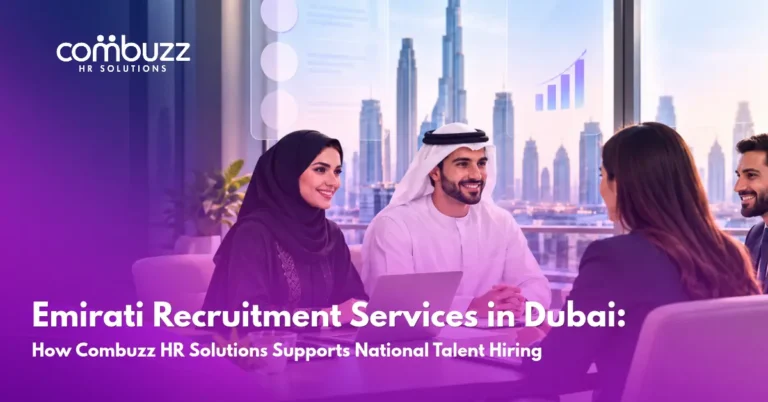
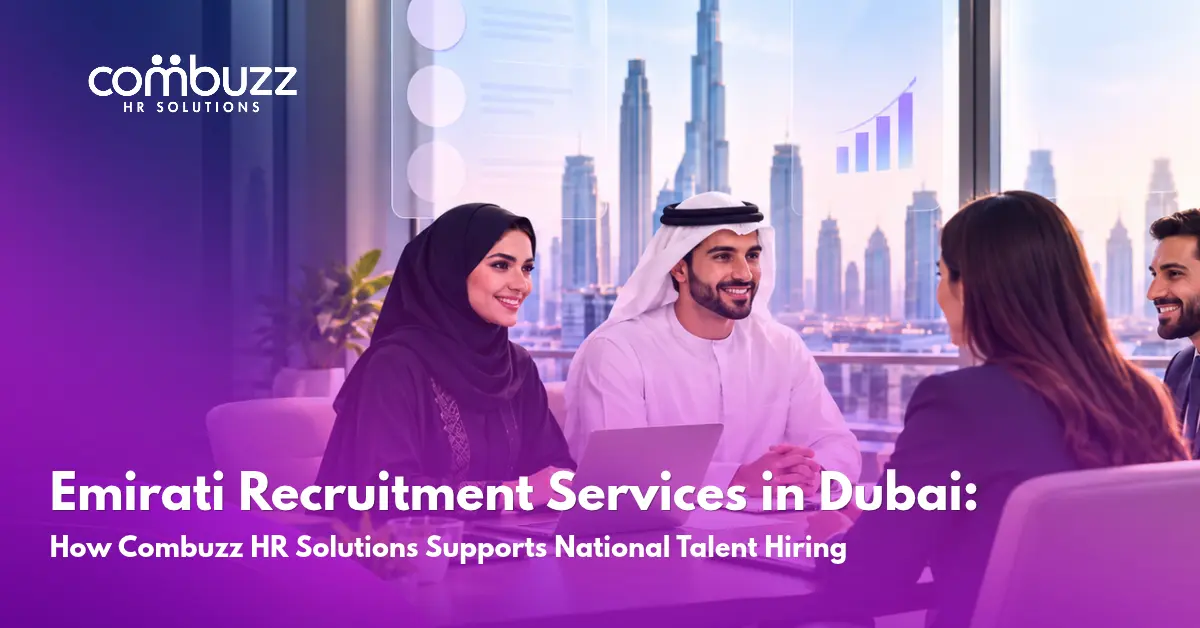
Hiring qualified Emirati professionals is becoming an increasingly important workforce priority for businesses in Dubai. For many private-sector employers, the challenge is not simply identifying a UAE national candidate. It is finding someone with the right skills, placing them in a meaningful role and providing the conditions for a successful long-term career.
Consider a Dubai company that needs to recruit an Emirati finance specialist. Its HR team has already advertised the vacancy, but the applications do not fully match the required experience. Meanwhile, management needs to meet its recruitment plans and understand the company’s Emiratisation responsibilities.
This is where specialised Emirati recruitment services in Dubai can provide practical support.
A recruitment partner can help employers define realistic job requirements, reach relevant UAE national candidates, assess capabilities and coordinate the hiring process.
At Combuzz HR Solutions, our approach to Emirati talent acquisition brings together candidate sourcing, recruitment planning, screening and hiring support. The aim is to connect employers with qualified UAE nationals whose skills and career objectives match genuine business opportunities.
This guide explains how Emirati recruitment works, which UAE requirements employers should understand, and how Combuzz supports companies building sustainable national talent pipelines.
Table of Contents
- What are Emirati recruitment services?
- Why Emirati recruitment matters to UAE businesses
- UAE Emiratisation requirements in 2026
- Challenges employers face when hiring UAE nationals
- How Combuzz HR Solutions supports Emirati recruitment
- The step-by-step Emirati recruitment process
- Emirati graduate, specialist and leadership recruitment
- How Nafis fits into national talent hiring
- Building a successful Emirati retention strategy
- Emirati recruitment agency vs internal hiring
- Industry-specific recruitment considerations
- Measuring Emirati recruitment performance
- Practical employer hiring scenarios
- Common hiring mistakes to avoid
- Employer recruitment checklist
- Frequently asked questions
- Partner with Combuzz HR Solutions
1. What Are Emirati Recruitment Services in Dubai?
Emirati recruitment services are specialised hiring services designed to help employers identify, evaluate and recruit qualified United Arab Emirates nationals.
They support organisations that need Emirati employees for professional, technical, administrative, management and leadership positions.
Unlike a purely transactional hiring process, an effective Emirati recruitment strategy should consider both the vacancy and the candidate’s future within the organisation.
Typical services include:
- Workforce needs assessment
- Emirati recruitment strategy development
- Candidate sourcing through professional networks
- Graduate and early-career talent identification
- Candidate screening and shortlisting
- Skills and competency assessment
- Interview scheduling and coordination
- Offer and hiring process support
- Candidate communication
- Recruitment planning for future vacancies
Some employers need one specialised professional. Others may require several Emirati employees across multiple departments.
The recruitment approach should reflect the nature of those requirements.
What Is the Difference Between Emirati Recruitment and Emiratisation?
Although the terms are closely connected, they do not mean exactly the same thing.
Emirati recruitment refers to attracting, assessing and hiring UAE national candidates for employment opportunities.
Emiratisation is the wider UAE policy framework intended to increase meaningful participation by UAE nationals in the workforce, particularly within the private sector.
Recruitment is one important component of Emiratisation. Employers must also consider applicable employment obligations, workforce planning, retention and genuine work arrangements.
A successful hiring programme should support both business performance and national workforce objectives.
2. Why Emirati Recruitment Matters to UAE Businesses
For employers, national talent hiring combines workforce development with important regulatory considerations.
The strongest approach is to recruit Emirati professionals because they can contribute to meaningful business outcomes, not simply to fill a numerical vacancy.
Access to Local Market Knowledge
Emirati professionals can bring valuable knowledge of the UAE’s business environment, customer expectations and professional networks.
These capabilities can be particularly useful in roles involving local market development, government coordination, stakeholder engagement and customer relationships.
However, employers should assess each individual based on their relevant experience and skills rather than make assumptions based on nationality.
Building a Sustainable Workforce
Developing internal talent helps organisations create greater continuity in important functions.
Graduate programmes, mentorship, structured training and clear career pathways can contribute to a stronger workforce pipeline.
A company that recruits an Emirati graduate into an entry-level finance position, for example, can provide opportunities to develop into a specialist or management role.
The outcome depends on the organisation’s investment in training and employee development.
Supporting Emiratisation Obligations
Certain UAE private-sector establishments are required to achieve Emiratisation targets.
Hiring eligible UAE nationals into genuine roles is an important part of meeting those requirements.
Recruitment must be accompanied by appropriate employment contracts, work permits, wage payments and other applicable administrative obligations.
Strengthening Employer Branding
Employers that offer meaningful career development, transparent compensation and professional workplace experiences may become more attractive to talented candidates.
Good employer branding is not only about vacancy advertisements.
It also includes the recruitment experience, quality of management, workplace culture and opportunities for advancement.
Developing Future Leaders
A well-planned national talent programme can support future managerial and specialist capabilities.
Organisations should identify positions where current hiring can contribute to longer-term succession planning.
This creates a stronger commercial reason for recruitment and can improve the quality of workforce planning.
3. Understanding UAE Emiratisation Requirements in 2026
Employers should understand the difference between national recruitment objectives and specific obligations imposed under UAE regulations.
Not every UAE business has identical Emiratisation requirements.
The applicable rules depend on factors including workforce size, economic activity and the relevant employment framework.
Establishments With 50 or More Employees
According to guidance published by the Ministry of Human Resources and Emiratisation (MOHRE), private-sector establishments covered by the requirement and employing 50 or more workers are expected to increase Emiratisation in skilled positions by two percentage points annually.
The framework targets a 10% Emiratisation rate in skilled jobs by the end of 2026, with semi-annual increases of one percentage point.
Employers should confirm the exact target calculated for their establishment through MOHRE systems rather than estimating compliance from total headcount alone.
Establishments With 20–49 Employees
MOHRE also introduced requirements for private-sector establishments with 20–49 employees operating in specified economic activities.
The relevant framework required covered establishments to appoint at least one UAE national during 2024 and another additional national employee during 2025.
Employers should check their current position, previous obligations and any subsequent official updates.
The rules should not be interpreted as applying automatically to every company with 20–49 employees.
What Happens if Employers Do Not Meet Applicable Targets?
The Emiratisation framework provides for financial contributions and other enforcement measures where covered establishments fail to meet their obligations.
The amount and application of a contribution depend on the relevant rule, period and nature of non-compliance.
For establishments subject to the main 50-plus-worker framework, MOHRE’s published schedule increased the monthly contribution per required but unappointed UAE national from AED 6,000 in 2022 by AED 1,000 each year through 2026.
Employers must verify their applicable assessments directly with MOHRE.
A recruitment agency can assist with identifying candidates, but it cannot guarantee regulatory compliance or remove an employer’s statutory responsibilities.
Genuine Employment Is Essential
Emiratisation is intended to create real employment opportunities.
A formal contract without a genuine working relationship may be treated as sham or fictitious Emiratisation.
Employers should ensure that recruited UAE nationals:
- Perform authentic job responsibilities
- Have suitable workplace resources
- Receive agreed wages through applicable payment arrangements
- Hold the necessary employment authorisations
- Receive appropriate training and supervision
- Are registered for applicable pension or social security requirements
Recruiting someone solely to appear on a workforce register creates serious compliance risk.
Regulatory reminder: These requirements reflect official guidance reviewed in October 2026. Employers should confirm current targets, contribution amounts, establishment classifications and administrative requirements through MOHRE or qualified advisers before making decisions.
4. Common Challenges When Hiring Emirati Professionals
Many UAE employers have genuine interest in recruiting national talent but encounter practical difficulties.
These challenges are not necessarily caused by a shortage of capable candidates. They often reflect how organisations define roles, reach applicants or structure their recruitment process.
Difficulty Reaching Relevant Candidates
General job advertisements may not reach professionals who match a specialised vacancy.
Some suitable candidates are already employed and may not be actively searching.
A targeted recruitment approach can help employers reach candidates through relevant professional networks and recruitment channels.
Unclear Job Requirements
A vacancy description may combine responsibilities from several different positions.
For example, an employer may seek an entry-level national candidate while requiring extensive specialist experience and management responsibilities.
These inconsistencies can limit the candidate pool.
Before recruitment begins, hiring managers should distinguish essential skills from those that can be developed through training.
Competitive Hiring Markets
Experienced candidates may receive interest from employers across several sectors.
To attract qualified professionals, businesses need to present a credible opportunity with suitable responsibilities, remuneration and career prospects.
An employer’s reputation and recruitment experience can influence candidate interest.
Delayed Selection Decisions
Lengthy interview procedures can create unnecessary uncertainty.
When roles remain unapproved or hiring managers cannot provide feedback, candidates may lose interest.
Structured recruitment processes help employers make timely, informed decisions.
Retention Concerns
A successful appointment does not guarantee long-term retention.
Employees need clarity about performance expectations, support during onboarding, opportunities for professional development and a respectful workplace.
Employers should consider retention before recruitment begins.
Understanding Administrative Requirements
Hiring a UAE national may involve specific work permit, pension, wage payment and Nafis-related procedures.
Businesses need to clarify which processes apply to the particular employment arrangement.
An HR or recruitment partner may assist with coordination, but the employer remains responsible for fulfilling applicable legal obligations.
5. How Combuzz HR Solutions Supports Emirati Recruitment in Dubai
Combuzz HR Solutions provides Emirati talent acquisition and recruitment services for businesses in Dubai and across the UAE.
Our published service offering includes recruitment strategy, candidate sourcing, screening, specialist and leadership recruitment, and support for employers seeking to build Emirati talent pipelines.
The process begins with understanding what the business needs from the person it plans to hire.
5.1 Understanding Workforce and Hiring Requirements
Before sourcing candidates, Combuzz works with the employer to clarify the position and its place within the organisation.
This may involve discussing:
- Job title and department
- Key responsibilities
- Qualifications and technical skills
- Required professional experience
- Reporting structure
- Workplace location
- Compensation expectations
- Career development opportunities
- Hiring priorities and expected timelines
This stage helps create a realistic position brief.
It is particularly important when a company is recruiting its first Emirati employee or establishing a new national talent programme.
5.2 Developing a Targeted Emirati Recruitment Strategy
Different vacancies require different sourcing approaches.
Recruiting a graduate for a junior HR role is not the same as finding an experienced Emirati operations manager.
Combuzz supports customised recruitment planning based on the employer’s industry, business objectives and role requirements.
The strategy can consider whether the position is suitable for early-career talent, experienced professionals or leadership candidates.
It can also identify which criteria must be met at appointment and which competencies may be developed after joining.
5.3 Emirati Candidate Sourcing
Combuzz uses recruitment networks, talent databases and relevant sourcing channels to identify UAE national candidates.
Its Emiratisation service page also describes candidate sourcing through professional networks, referrals, career events and university engagement initiatives.
These channels can help employers reach a broader range of potential applicants.
The objective is to identify people with relevant capabilities and genuine interest in the position.
Candidate availability and suitability will vary according to the vacancy, industry and labour market.
5.4 Screening and Shortlisting
An effective shortlist should demonstrate more than whether a candidate holds the required nationality and qualification.
Combuzz’s recruitment approach focuses on factors such as professional experience, qualifications, career aspirations and suitability for the role.
A structured screening process may evaluate:
Technical capability: Does the candidate have the knowledge or experience required for the responsibilities?
Relevant experience: Has the candidate worked in a similar function, industry or operational environment?
Communication: Can the candidate explain their experience and demonstrate the communication skills required for the position?
Career motivation: Does the opportunity align with the candidate’s interests and development goals?
Role expectations: Are the responsibilities, working arrangements and compensation understood?
Development potential: Where training is available, can the candidate reasonably develop the required capabilities?
The employer should make the final selection based on lawful, job-related criteria.
5.5 Interview and Selection Coordination
Combuzz supports employers through candidate shortlisting and interview coordination.
A consistent interview framework can make hiring decisions more reliable.
For example, all shortlisted applicants for a finance specialist position should be evaluated against the same essential technical requirements.
Using agreed interview questions and documented assessment criteria can reduce inconsistent decisions.
The hiring team should provide timely feedback to candidates and clarify any outstanding issues before making an offer.
5.6 Offer and Onboarding Coordination
Once a suitable candidate is selected, the process moves towards offer discussions and employment arrangements.
Combuzz’s broader recruitment services include offer coordination and hiring support.
Employers should clearly communicate the job title, remuneration structure, workplace arrangements, expected responsibilities and available development opportunities.
Formal employment documentation and any required registrations must follow the rules applicable to the employer and the employee.
A coordinated handover between recruitment and HR helps the new employee understand what will happen before and after joining.
5.7 Supporting Long-Term Talent Planning
An organisation may need to recruit several Emirati employees over time rather than fill one immediate vacancy.
Combuzz can support recruitment planning for different job functions and experience levels.
This gives employers an opportunity to build a more consistent approach to sourcing, assessment and candidate engagement.
A stronger talent pipeline can help reduce repeated recruitment efforts whenever a new vacancy arises.
6. Step-by-Step Emirati Recruitment Process for Employers
A structured process helps companies combine hiring quality with clear operational responsibilities.
Step 1: Review Workforce Requirements
Start by identifying the genuine business positions that require hiring.
Review current skills gaps, future projects, departmental needs and workforce plans.
If Emiratisation targets apply, confirm the organisation’s current obligations and eligible skilled positions using official information.
Do not create artificial roles solely to satisfy a numerical target.
Step 2: Create an Accurate Job Description
Document the responsibilities, minimum qualifications and essential competencies.
Separate required skills from preferred skills.
Include clear information about employment type, work location, reporting arrangements and any relevant working conditions.
The vacancy should describe an authentic opportunity.
Step 3: Establish a Hiring Budget
Confirm the approved compensation range and other employment costs.
Consider applicable pension contributions, recruitment expenses, training investment and operational requirements.
Employers should avoid assuming that any government support programme automatically replaces their contractual wage obligations.
Step 4: Select Appropriate Recruitment Channels
Depending on the role, recruitment channels may include professional networks, direct sourcing, career events, graduate outreach and specialised agencies.
Combuzz can help coordinate targeted candidate sourcing for employers seeking national talent.
Step 5: Screen Against Consistent Criteria
Use a scoring framework linked to the job’s actual requirements.
For example, candidates for an HR generalist position may be assessed on employment administration knowledge, communication, systems proficiency and problem-solving.
Document assessment outcomes to support transparent decision-making.
Step 6: Conduct Structured Interviews
Prepare job-related questions and ensure interviewers understand the evaluation criteria.
Use practical examples to assess relevant capabilities.
Avoid relying on subjective assumptions about personality or background.
Step 7: Confirm Offer and Employment Arrangements
Provide a clear written offer and complete the required employment procedures.
Confirm whether the company is subject to MOHRE or a different applicable authority.
The employer must ensure that relevant wage, permit and pension requirements are met.
Step 8: Prepare a Meaningful Onboarding Plan
Assign a reporting manager, arrange access to tools and systems, and explain performance expectations.
Where suitable, appoint a mentor or colleague to assist with integration.
A structured first 90 days can improve clarity for both the employee and manager.
Step 9: Monitor Progress and Retention
Conduct regular feedback discussions.
Review whether the employee is receiving the work, training and support originally described.
Where performance gaps arise, respond with appropriate coaching and clear expectations.
Step 10: Review Recruitment Outcomes
Evaluate whether the hiring process delivered the intended result.
Use metrics such as time to shortlist, offer acceptance, retention and hiring-manager satisfaction.
The objective is continuous improvement rather than simply counting completed appointments.
7. Graduate, Specialist and Leadership Emirati Recruitment
A national talent strategy should account for candidates at different career stages.
Graduate and Early-Career Recruitment
Fresh graduates may offer academic knowledge, motivation and the potential to develop valuable professional skills.
However, employers need realistic expectations.
A graduate role should not require the same professional experience as a senior specialist vacancy.
Effective graduate hiring may involve structured induction, supervised assignments, clear competency milestones and regular manager feedback.
For example, an Emirati business graduate joining a finance department could begin with reporting support and gradually take on broader responsibilities after training.
The development programme should reflect the employee’s actual capabilities and business needs.
Mid-Career and Specialist Recruitment
Experienced Emirati professionals may be suitable for technical, commercial, operational and management roles.
These searches often require more targeted sourcing.
Hiring teams should establish which qualifications are essential and whether experience from a related sector is transferable.
A candidate with strong operations experience in one industry may be able to succeed in another if the underlying competencies match.
Executive and Leadership Recruitment
Senior appointments require a different assessment process.
Employers should consider leadership capability, strategic decision-making, stakeholder management, relevant industry knowledge and experience managing teams or functions.
Combuzz’s Emirati talent acquisition services include support for specialist, management and executive recruitment.
The goal is to help employers identify professionals suited to positions with genuine organisational responsibility.
8. How Nafis Supports Emirati Employment
Nafis is a UAE government programme intended to improve the competitiveness and participation of UAE nationals in private-sector employment.
Its initiatives can include employment-related support, training and other benefits, subject to programme rules and eligibility.
For employers, it is important to understand that Nafis is not a substitute for sound recruitment or lawful employment practices.
Employers Should Verify Eligibility
Government support is not automatically available to every employee or employer.
Eligibility may depend on the programme, employment arrangement, salary and other specified conditions.
Companies should consult official Nafis and MOHRE guidance before promising a candidate any particular benefit.
Government Support Should Not Be Used to Reduce Agreed Wages
Employers must meet their own wage obligations.
Applicable Emiratisation rules prohibit reducing an Emirati employee’s wage because the individual receives government support.
Recruitment communications should therefore distinguish the employer’s compensation offer from any independently administered programme benefit.
Recruitment Advertisements Must Be Genuine
MOHRE’s Emiratisation compliance rules prohibit misleading job advertisements that do not represent genuine opportunities.
There are also restrictions on how certain government policies and support benefits may be referenced in advertisements.
Employers should review recruitment communications before publishing them.
Employers Must Meet Documentation Requirements
Relevant obligations may include obtaining the appropriate work permit, concluding a compliant employment contract, paying wages through applicable systems and completing pension or social security registration.
The employer should confirm the precise obligations based on the employee and applicable employment framework.
A recruitment partner can help with hiring coordination, but the employer must maintain its own compliance controls.
9. Building a Long-Term Emirati Talent Retention Strategy
Recruiting a qualified candidate is only the beginning.
Employers also need to create an environment in which that person can contribute, learn and progress.
Set Clear Expectations From the Start
The employee should understand the purpose of the role, expected outputs and how performance will be assessed.
Unclear responsibilities can create frustration for both employees and managers.
Provide Meaningful Work
A genuine position should involve responsibilities that contribute to the organisation.
Employees should have suitable resources and access to the systems needed to perform their duties.
Meaningful employment is also an important consideration under Emiratisation compliance requirements.
Build a Development Plan
A development plan can identify skills the employee already possesses and areas where additional learning would be useful.
Training may include technical courses, supervised assignments, management development or relevant professional qualifications.
The plan should be specific rather than a general promise of future advancement.
Encourage Regular Manager Feedback
Managers should discuss progress, challenges and expectations throughout the year.
Employees benefit from knowing what they are doing well and where improvement is needed.
A clear feedback process can also help identify issues before they become reasons for resignation.
Establish Fair Progression Opportunities
Career progression should be connected to competencies, performance and organisational opportunities.
Employers should communicate the requirements for more advanced roles and support employees who want to develop those capabilities.
Measure Retention Outcomes
Monitor employee retention at meaningful intervals, such as six and 12 months.
Where turnover occurs, review available exit feedback and workplace factors.
A high-quality recruitment process should be evaluated partly by whether employees remain suitable and engaged after joining.
10. Emirati Recruitment Agency vs Internal HR Recruitment
Employers may recruit UAE national candidates directly or work with a specialised agency.
An external recruitment partner does not replace the internal HR function. It can provide additional sourcing and assessment capacity.
| Consideration | Internal HR recruitment | External Emirati recruitment partner |
|---|---|---|
| Candidate sourcing | Internal channels and networks | Additional agency channels and candidate networks |
| Job knowledge | Strong understanding of company operations | Requires a detailed employer briefing |
| Search capacity | Depends on HR workload | Additional resources within agreed scope |
| Specialist recruitment | Depends on internal experience | Can support targeted searches |
| Candidate screening | Internal selection process | Agency screening plus employer evaluation |
| Hiring decision | Employer | Employer |
| Employment obligations | Employer | Employer retains applicable obligations |
| Cost | Internal staff time and hiring costs | Agreed recruitment service fees |
| Best use | Established pipelines and regular hiring | Specialist roles, additional capacity and hard-to-fill vacancies |
When Should Employers Use an Agency?
External recruitment assistance can be particularly valuable when:
- The business lacks direct access to suitable Emirati candidates.
- Several vacancies need to be recruited simultaneously.
- Internal recruiters are managing competing priorities.
- The role requires specialised experience.
- The employer is establishing a national talent hiring programme.
- Additional screening and candidate coordination would improve the process.
Looking to hire Emirati professionals in Dubai or across the UAE?
Explore our Emirati Talent Acquisition and Emiratisation Services to learn how Combuzz supports national talent recruitment.
Before engaging an agency, employers should confirm the scope of services, commercial terms, reporting arrangements and expectations for candidate shortlists.
11. Industry-Specific Emirati Recruitment Considerations
National talent requirements vary across industries.
Employers should adapt job descriptions, assessment criteria and development plans to the actual business function.
Banking and Financial Services
Recruitment may focus on finance, risk, compliance, customer relationships, operations and management.
Certain regulated positions may require specific qualifications or experience.
Employers should distinguish sector-specific staffing requirements from the general Emiratisation framework.
Healthcare
Healthcare employers may require qualified professionals for clinical, technical and administrative positions.
Regulated clinical roles must meet applicable professional licensing requirements.
Candidate nationality does not replace qualification or licensing checks.
Information Technology and Digital Services
Technology employers may seek professionals in software development, cybersecurity, data analysis, systems support and digital operations.
Practical technical assessments can help determine whether candidates have the competencies needed for specialised roles.
Retail and Hospitality
These sectors may offer positions in operations, customer experience, administration, human resources, finance and management.
Employers should assess working arrangements, training needs and opportunities for career progression.
Engineering and Industrial Operations
Technical vacancies may require specific engineering qualifications, site experience or industry knowledge.
Graduate development programmes can provide one approach to building future technical capacity.
Government and Semi-Government Organisations
Government and semi-government entities may have recruitment processes and staffing frameworks different from those applicable to private-sector businesses.
Any applicable requirements should be assessed separately.
Combuzz’s Emirati recruitment offering covers multiple sectors and job functions, allowing employers to discuss requirements that reflect their industry and position level.
12. How to Measure Emirati Recruitment Success
Employers should track recruitment quality as well as hiring volume.
A balanced performance framework provides a clearer picture of whether the hiring strategy is working.
| KPI | What it measures | Why it matters |
|---|---|---|
| Time to shortlist | Days from vacancy approval to qualified shortlist | Indicates sourcing responsiveness |
| Qualified shortlist rate | Proportion meeting essential criteria | Measures relevance of candidate sourcing |
| Interview-to-offer ratio | Interviews required per offer | Helps assess screening quality |
| Offer acceptance rate | Accepted offers divided by offers issued | Indicates candidate and offer alignment |
| Time to hire | Days from approval to accepted offer | Supports workforce planning |
| Onboarding completion | Completion of agreed induction activities | Shows preparation and integration |
| Six-month retention | Employees remaining after six months | Early indication of retention |
| Twelve-month retention | Employees remaining after a year | Supports longer-term workforce assessment |
| Hiring-manager satisfaction | Structured feedback on recruitment outcomes | Measures operational usefulness |
| Target progress | Progress against applicable Emiratisation requirements | Supports internal compliance monitoring |
No single KPI proves that an employee is successful or that a business is compliant.
For example, a fast recruitment process may still produce poor results if the role is unsuitable.
Similarly, recruiting the required number of employees does not remove the need for genuine employment, accurate documentation and lawful working arrangements.
Suggested Recruitment Reporting Rhythm
A useful management dashboard can be reviewed monthly.
It may include active vacancies, sourcing progress, interview outcomes, offers, joining dates and early retention indicators.
Compliance-related reporting should also be reviewed at the intervals required by the relevant authority.
This supports better coordination between recruitment, HR, finance and business leaders.
13. Practical UAE Employer Scenarios
The following scenarios are hypothetical examples designed to illustrate recruitment decisions. They are not Combuzz client case studies.
Scenario 1: A Dubai SME Hiring Its First Emirati HR Professional
A medium-sized services business plans to recruit an Emirati HR coordinator.
The HR manager needs someone who can support employee records, onboarding and general administration.
Rather than asking for several years of specialist experience, the company identifies essential communication and organisational skills and prepares an induction plan.
A recruitment partner helps source suitable early-career candidates, while the employer conducts final interviews and approves the appointment.
Key lesson: Clear job requirements and realistic development expectations can make recruitment more productive.
Scenario 2: A Financial Services Employer Seeking an Experienced Candidate
A regulated financial services organisation needs an experienced UAE national compliance professional.
The role requires detailed technical knowledge and an understanding of internal governance.
The company uses targeted sourcing and structured competency interviews rather than relying only on general job advertisements.
Key lesson: Specialist recruitment requires relevant experience assessment, careful sourcing and appropriate checks.
Scenario 3: A Growing Company Building a National Talent Pipeline
A Dubai business expects several vacancies across finance, HR and operations over the next year.
Instead of recruiting each role in isolation, management develops a workforce plan with hiring priorities and expected timelines.
The employer uses consistent selection criteria, establishes relationships with suitable candidates and reviews progress monthly.
Key lesson: A planned recruitment pipeline can support organisational growth more effectively than repeated last-minute searches.
14. Common Emirati Recruitment Mistakes Employers Should Avoid
Treating Emirati Recruitment as a Numerical Exercise
The purpose should be genuine employment in meaningful roles.
Hiring without an authentic job or working relationship can create serious regulatory consequences.
Using Unrealistic Job Descriptions
Employers sometimes require senior-level experience for positions intended for graduates.
This limits the candidate pool and can make hiring more difficult.
Relying on One Recruitment Channel
A single job advertisement may not reach experienced candidates.
Employers should consider several relevant sourcing methods.
Delaying Interview Feedback
Unclear timelines can damage the candidate experience.
Recruitment teams should agree on internal decision deadlines and communicate updates.
Confusing Government Support With Employer Compensation
Applicable government programmes have their own eligibility requirements.
Employers remain responsible for their agreed wages and legal employment obligations.
Neglecting Onboarding
A candidate may accept an offer but struggle when responsibilities, reporting lines or training arrangements are unclear.
Onboarding should be planned before the joining date.
Ignoring Employee Development
Recruitment and retention are connected.
Without useful work, feedback and growth opportunities, employers may struggle to build long-term national talent capacity.
Assuming an Agency Guarantees Compliance
A recruitment provider supports sourcing and hiring, but the employer retains its applicable statutory responsibilities.
Compliance should be reviewed independently of recruitment progress.
15. Employer Checklist for Hiring Emirati Talent in Dubai
Before launching a recruitment campaign, confirm the following.
Workforce planning
- We understand our current and forecast workforce needs.
- We have reviewed applicable Emiratisation requirements.
- The vacancy represents a genuine business role.
- Management has approved the position and budget.
- The required skills and qualifications are realistic.
Candidate recruitment
- We have selected appropriate sourcing channels.
- Our advertisements accurately describe the opportunity.
- Candidates will be assessed against consistent job-related criteria.
- Interviewers understand the evaluation process.
- We have agreed internal hiring decision timelines.
Employment administration
- We know which authority governs the employment arrangement.
- Required permits and contracts will be completed.
- Wage payment and pension requirements have been reviewed.
- Any Nafis-related matters will be verified through official channels.
- HR will maintain accurate employee documentation.
Retention and development
- A manager has been assigned to the employee.
- An onboarding plan is ready.
- Training requirements have been identified.
- Performance expectations are documented.
- Regular feedback meetings are scheduled.
Recruitment partner evaluation
- The agency understands the required role and industry.
- Candidate sourcing and screening methods are clear.
- The employer retains final hiring approval.
- Commercial terms and deliverables are documented.
- Reporting and communication arrangements are agreed.
Completing this checklist can help employers prepare for a more structured and effective national talent recruitment process.
16. Frequently Asked Questions
1. What are Emirati recruitment services in Dubai?
Emirati recruitment services help employers find and hire qualified UAE nationals for genuine employment opportunities. They may include workforce planning, candidate sourcing, screening, shortlisting, interview coordination and recruitment support. These services are relevant to businesses recruiting graduates, experienced specialists, managers or senior professionals. A specialised recruitment agency can provide additional access to candidate networks and help employers assess applicants against job-specific requirements. The employer remains responsible for final hiring decisions and applicable legal obligations. Effective recruitment should consider both the immediate vacancy and the candidate’s potential contribution to the organisation over time.
2. How does Combuzz HR Solutions support Emirati recruitment?
Combuzz HR Solutions supports Emirati talent acquisition through recruitment planning, sourcing, candidate screening and coordination with employers. Its published service offering covers UAE national candidates across multiple functions, including graduates, experienced professionals and leadership positions. The process begins with understanding the employer’s job requirements and workforce objectives. Combuzz then supports identifying and evaluating suitable candidates for the role. The employer reviews the shortlist, conducts its selection process and makes the final hiring decision. Businesses can contact Combuzz to discuss their required roles, hiring plans and the appropriate scope of recruitment support.
3. Is Emiratisation mandatory for all companies in Dubai?
No. Specific Emiratisation targets do not apply identically to every Dubai company. MOHRE’s published framework includes requirements for covered private-sector establishments with 50 or more employees and separate obligations for establishments with 20–49 workers in selected economic activities. The applicable rules depend on matters such as workforce size, establishment classification, business activity and employment jurisdiction. Companies should check their obligations through the relevant authority instead of assuming that all organisations follow the same targets. Employers must also comply with the general employment rules that apply to their workers, whether or not a specific Emiratisation target covers them.
4. What is the Emiratisation target for companies with 50 or more employees in 2026?
Under MOHRE’s published framework, covered private-sector establishments with 50 or more workers are expected to increase Emiratisation in skilled positions by two percentage points annually, reaching a 10% target by the end of 2026. The framework also provides for semi-annual increases. An establishment’s actual obligations and compliance status must be confirmed through the applicable government systems. Employers should not calculate their target using total workforce numbers without considering the relevant skilled-worker classifications and other rules. The appropriate approach is to verify the official target and recruit qualified nationals into genuine, properly documented roles.
5. Do companies with 20–49 employees need to hire Emirati nationals?
Certain private-sector establishments with 20–49 employees are covered by additional Emiratisation requirements if they operate in specified economic activities. Under the published framework, covered establishments were required to recruit one UAE national during 2024 and another additional national employee during 2025. This does not mean every company with 20–49 workers is automatically covered. Employers should review their activity classification, official notifications and current compliance position. They should also verify whether subsequent requirements or administrative updates apply. A recruitment partner can assist in identifying candidates, but the employer must confirm its own legal obligations.
6. How can businesses find qualified Emirati candidates?
Businesses can use a combination of professional networks, structured job advertisements, university engagement, referrals, specialised recruitment agencies and relevant recruitment platforms. The most effective channels depend on the position and candidate experience level. Graduate recruitment may benefit from early-career outreach, while specialist and leadership appointments may require more targeted searches. Employers should first prepare a realistic job description and agree on the essential selection criteria. A recruitment partner such as Combuzz can support candidate sourcing and shortlisting. Companies should then use structured interviews and relevant assessments to determine suitability for the actual job.
7. What is the role of Nafis in Emirati recruitment?
Nafis is a UAE government initiative designed to support the competitiveness and employment of UAE nationals in the private sector. Its programmes may provide various forms of support or development opportunities, depending on eligibility and programme conditions. Employers should verify current Nafis requirements through official channels before making commitments to candidates. Nafis does not replace an employer’s responsibilities regarding wages, lawful employment arrangements and applicable administrative requirements. A sound Emirati recruitment strategy should focus on genuine jobs, suitable candidates, meaningful work and career development rather than treating government support as the main reason for hiring.
8. Can Combuzz help recruit Emirati graduates?
Yes. Combuzz’s published Emirati talent acquisition services include support for employers seeking graduates and early-career UAE national candidates. Graduate recruitment works best when businesses clearly distinguish essential entry-level capabilities from skills that can be developed after joining. Employers should provide accurate job descriptions, realistic expectations and an organised induction process. Where appropriate, structured training, mentoring and regular feedback can help new professionals build confidence and experience. Combuzz can support the recruitment and selection process, while the employer is responsible for providing suitable work, supervision and any agreed development opportunities.
9. Can Combuzz recruit experienced Emirati managers and executives?
Combuzz’s Emiratisation service offering includes recruitment support for experienced professionals, department heads, managers, technical specialists and executive positions. Senior recruitment typically requires a more targeted process than graduate sourcing. Employers should specify the leadership responsibilities, relevant experience, professional knowledge and decision-making capabilities required. Assessments should focus on evidence of suitability for the role, including achievements and job-related competencies. Combuzz can assist with identifying and screening candidates, while the employer remains responsible for interviews, final selection and employment decisions. The appropriate search strategy depends on the vacancy, industry and availability of suitable professionals.
10. What industries can benefit from Emirati recruitment services?
Emirati recruitment services may support businesses across financial services, healthcare, information technology, retail, hospitality, engineering, manufacturing, administration and other sectors. The relevant roles differ according to each industry’s operational requirements. For example, financial services employers may seek compliance specialists, while technology companies may need software or cybersecurity professionals. Healthcare and other regulated industries may require specific professional licences in addition to academic qualifications. Recruitment agencies can assist with sourcing and assessment, but employers must verify applicable sector requirements. A strong recruitment programme aligns national talent hiring with actual organisational needs and career development opportunities.
11. How long does it take to recruit an Emirati employee in Dubai?
There is no single recruitment timeline that applies to every Emirati vacancy. The duration depends on the role’s seniority, required skills, candidate availability, salary expectations, interview process and administrative requirements. General administrative or graduate roles may have different recruitment characteristics from specialised technical or executive positions. Employers can improve efficiency by approving the budget early, preparing a clear job description, using suitable sourcing channels and providing timely interview feedback. Recruitment agencies may add sourcing capacity, but they cannot guarantee that every role will be filled within a fixed period. Quality and suitability should remain central considerations.
12. Does hiring an Emirati employee automatically ensure Emiratisation compliance?
No. Hiring a UAE national does not automatically establish that every applicable Emiratisation requirement has been met. Employers need to confirm whether the employee and position qualify under the relevant rules and ensure the employment relationship is genuine. Applicable work permits, contracts, wage payments, pension registration and other obligations must also be completed correctly. The business must review its overall establishment-level requirements, including relevant workforce classifications and targets. Sham Emiratisation or inaccurate records can create enforcement risks. Employers should verify their compliance position through official government channels and obtain professional advice where requirements are unclear.
13. How can employers improve Emirati employee retention?
Retention starts with accurate recruitment expectations. Candidates should understand the role, compensation, workplace conditions and available development opportunities before accepting an offer. After joining, employees benefit from clear objectives, suitable tools, manager support and useful work. Employers should establish onboarding plans, regular feedback and development opportunities connected to genuine business needs. Retention can be monitored through six- and 12-month reviews, employee feedback and relevant performance measures. There is no universal programme that guarantees retention. Organisations should identify what their employees need to succeed and address workplace issues through consistent management practices.
14. Should a company hire Emirati talent internally or use a recruitment agency?
Both approaches can be effective. Internal recruitment may work well when an employer has strong candidate networks, sufficient HR capacity and experience filling similar roles. An external recruitment agency can provide additional sourcing channels, specialist recruitment knowledge and screening support, particularly for hard-to-fill positions or multiple vacancies. Businesses should compare the resources required, urgency, role complexity and commercial terms. Using an agency does not transfer final hiring responsibility or legal employment obligations away from the employer. A practical approach may combine internal HR oversight with external candidate sourcing and assessment assistance.
15. How can a business start Emirati recruitment with Combuzz HR Solutions?
The first step is to identify the position or workforce requirement. Employers should prepare information about the job, responsibilities, preferred qualifications, experience, location, compensation range and expected hiring schedule. Combuzz HR Solutions can then discuss the company’s recruitment objectives and the appropriate support scope. This may include targeted sourcing, candidate screening and interview coordination. Businesses with several expected vacancies may also discuss a broader national talent recruitment plan. To begin, employers can visit Combuzz’s Emiratisation service page or contact its recruitment team to request a consultation and discuss next steps.
17. Partner With Combuzz HR Solutions for Emirati Recruitment in Dubai
Recruiting Emirati professionals requires a balance of business needs, candidate suitability and responsible workforce planning.
A strong hiring strategy starts with genuine vacancies, realistic selection criteria and clear employment expectations.
It should also provide employees with meaningful work and opportunities to develop their capabilities.
Combuzz HR Solutions supports organisations seeking qualified UAE national talent through specialised recruitment planning, candidate sourcing and selection coordination.
Whether your business is hiring an Emirati graduate, seeking an experienced specialist or developing a wider national talent pipeline, the recruitment approach should reflect your actual workforce requirements.
Looking to hire Emirati professionals in Dubai or across the UAE?
Contact Combuzz HR Solutions to discuss your vacancies and request an Emirati recruitment consultation.