Introduction
Hiring the wrong person in the UAE does not just cost you a salary. It costs you visa fees, onboarding time, a gap in your team, and sometimes a labour dispute you did not see coming.
That is why so many companies operating across the UAE and GCC no longer try to handle recruitment alone. They bring in a recruitment partner who already understands the labour market, the visa rules, and where to find the right talent fast.
This guide walks you through how recruitment services in the UAE and GCC actually work, what they cost, the legal side you cannot afford to ignore, and how to pick a partner who will get it right the first time.
1. What Are Recruitment Services in the UAE and GCC?
Recruitment services cover the full job of finding, screening, and placing candidates on behalf of an employer. In the UAE and GCC, this usually means a licensed agency manages sourcing, interviews, reference checks, and offer negotiation, so the hiring company only sees the shortlist.
Some agencies focus on volume roles like warehouse staff or retail teams. Others specialise in executive search for CFOs, general managers, or country heads. Combuzz HR Solutions works across both ends, matching the recruitment model to the role rather than using one approach for everything.
It’s worth separating recruitment from two things people often confuse it with. Recruitment finds and places talent. Staffing supplies workers on a temporary or contract basis. Employer of Record hires the worker legally on your behalf once they’re found. Many companies end up needing more than one of these at different stages of growth.
2. Why Businesses Use Recruitment Agencies Instead of Hiring Directly
Direct hiring sounds cheaper on paper. In practice, it often costs more once you count the time, the missed candidates, and the compliance risk.
Speed. A good agency already has a pipeline of vetted candidates. Instead of starting from zero, you’re reviewing people who are pre-screened against your role within days.
Market knowledge. Salary benchmarks shift across Dubai, Abu Dhabi, and the northern Emirates. An agency active in the market daily knows what a role should pay before you post it and overprice or underprice yourself out of good candidates.
Access to passive candidates. The strongest people in the UAE job market are usually not applying anywhere. They’re employed and quietly open to the right offer. Agencies reach them through networks a job advert never will.
Compliance protection. Federal Decree-Law No. 33 of 2021 on the Regulation of Labour Relations governs employment across the UAE private sector, and it changes how offer letters, probation periods, and end-of-service terms need to be written. A recruitment partner who works inside this law daily catches mistakes before they become disputes.
Reduced hiring risk. Most reputable agencies offer a replacement guarantee, typically 90 days, so if a placement doesn’t work out, you’re not paying twice.
3. Types of Recruitment Services Available in the UAE
Not every hire needs the same approach. Here’s how the main service types break down.
Permanent Recruitment
Full-time, direct hire placements where the candidate joins your payroll. This is the standard model for most roles from mid-level staff through to senior management.
Executive Search
A dedicated, research-led process for C-suite, general management, and specialist leadership roles. This usually involves confidential headhunting rather than advertised vacancies, since senior candidates rarely apply through job boards.
Contract and Temporary Staffing
Ideal for project-based work, seasonal demand, or roles where headcount flexibility matters more than long-term commitment. The agency or an EOR partner typically holds the employment contract.
Recruitment Process Outsourcing (RPO)
For companies hiring at volume, RPO hands over some or all of the recruitment function to an external partner who works as an extension of your HR team, often at a lower cost per hire than running it internally.
Bulk and Blue-Collar Recruitment
Common in construction, logistics, hospitality, and manufacturing. This involves sourcing at scale, often including candidates recruited from outside the UAE, with visa processing built into the service.
Domestic Worker Recruitment
A separately regulated category under the UAE’s Domestic Workers Law. Only recruitment offices specifically licensed for this activity by MOHRE can place domestic workers, and the rules around recruitment fee refunds are strict.
| Service Type | Best For | Typical Timeline |
|---|---|---|
| Permanent Recruitment | Full-time roles, all levels | 2–6 weeks |
| Executive Search | Leadership, C-suite | 6–12 weeks |
| Contract Staffing | Project or seasonal work | 1–3 weeks |
| RPO | High-volume, ongoing hiring | Ongoing partnership |
| Bulk Recruitment | Blue-collar, large teams | 4–10 weeks |
| Domestic Worker Recruitment | Household staff | 2–6 weeks |
4. How Recruitment Works Across the Wider GCC
Recruitment doesn’t run on one rulebook across the Gulf. Each country layers its own labour law, quota system, and visa process on top of the basics.
Saudi Arabia enforces Saudisation through the Nitaqat programme, which sets minimum quotas for Saudi nationals by sector and company size. Recruitment partners here need to plan around those quotas from day one, not after the offer is made.
Qatar runs its own Qatarisation targets and requires Ministry of Labour approval for most work visas, with processes that shift periodically, particularly around major national events and infrastructure cycles.
Oman has tightened Omanisation requirements across several sectors in recent years, with certain job titles reserved exclusively for Omani nationals.
Bahrain operates a more liberalised labour market relative to its neighbours but still applies localisation targets through its Labour Market Regulatory Authority.
Kuwait applies strict nationality quotas by sector and has periodically restricted expatriate hiring in specific fields, making local market knowledge essential before you commit to a role.
A recruitment partner with genuine GCC-wide reach, rather than UAE-only experience relabelled as regional, is what actually protects you from missteps when you expand beyond Dubai or Abu Dhabi.
5. The Recruitment Process, Step by Step
Here’s what a properly run recruitment engagement looks like from first conversation to signed offer.
Step 1: Role scoping. The agency sits with you to understand the role, the team it sits in, the salary band, and what “good” actually looks like beyond the job description.
Step 2: Market mapping. For senior or hard-to-fill roles, this means identifying which companies hold the talent you need and who within them is a realistic move.
Step 3: Sourcing and screening. Candidates are pulled from the agency’s database, referrals, and targeted outreach, then screened against your must-haves before you ever see a CV.
Step 4: Shortlist presentation. You receive a curated shortlist, usually three to six candidates, with a summary of strengths, salary expectations, and notice period for each.
Step 5: Interviews. The agency coordinates scheduling and, ideally, gives you honest feedback from both sides after each round.
Step 6: Offer and negotiation. The agency manages salary negotiation, counter-offer risk, and start date, which is where deals most often fall apart without an experienced intermediary.
Step 7: Visa and onboarding support. For candidates relocating or switching sponsors, this covers offer letter compliance, labour contract registration, and visa processing through MOHRE and the relevant free zone or ICP channel.
Step 8: Post-placement follow-up. A good agency checks in during the probation period, not just at signing, and stands behind a replacement guarantee if the placement doesn’t work out.
6. Legal and Regulatory Framework You Need to Know
Recruitment in the UAE sits inside a defined legal structure, and getting this wrong is where most compliance risk hides.
Federal Decree-Law No. 33 of 2021 governs private sector labour relations across the UAE mainland, covering contract types, probation limits, notice periods, and end-of-service gratuity. Free zones like DIFC and ADGM operate under their own employment regulations, which differ in places from mainland federal law.
MOHRE licensing is mandatory for any recruitment or staffing agency operating in the UAE. As of 2026, the industry has faced tighter enforcement: regulators issued 135 fines against 42 domestic worker recruitment offices in the first half of the year alone, mostly for delays in refunding recruitment fees to employers. It’s a reminder that working only with licensed, compliant agencies genuinely protects you.
Wage Protection System (WPS) requires salaries to be paid through an approved system within set deadlines, and this applies regardless of whether the employee was sourced through an agency or hired directly.
Corporate Tax now applies at 9% on net taxable income above AED 375,000, which matters for any staffing or EOR arrangement where the recruitment partner also handles payroll.
Nafis is the UAE’s national programme to increase Emirati participation in the private sector, and recruitment for many roles now needs to account for Emiratisation quotas alongside the standard hiring criteria.
Regulations in this space move quickly. Always confirm the latest requirements directly through MOHRE, the ICP, or Dubai Economy before finalising a hiring plan.
7. Recruitment Fees and Pricing Models
Pricing varies by role seniority, industry, and service type. Here’s how the main models compare.
| Pricing Model | How It Works | Common For |
|---|---|---|
| Contingency (Success Fee) | Paid only when a candidate is hired, typically 10–20% of annual salary | Mid-level, standard roles |
| Retained Search | Upfront fee plus milestone payments, regardless of outcome timing | Executive and C-suite roles |
| RPO Monthly Retainer | Fixed monthly fee covering ongoing recruitment activity | High-volume or continuous hiring |
| Placement Fee (Blue-Collar) | Flat fee or percentage per worker placed, often bundled with visa processing | Bulk and labour-intensive recruitment |
Contingency recruitment feels lower-risk since you only pay on success, but it can mean the agency is working several roles at once and yours isn’t always the priority. Retained search costs more upfront but usually gets dedicated attention and a stronger, more thoroughly vetted shortlist.
Whichever model you choose, get the replacement guarantee terms in writing before signing anything. A verbal promise is not worth much if a hire doesn’t work out at month two.
8. Recruitment Agency vs In-House HR Team
This isn’t really an either-or decision for most growing companies. It’s about where each option earns its keep.
In-house HR works well when hiring volume is steady, roles are similar to ones you’ve filled before, and your HR team already has strong networks in that specific talent pool.
External recruitment agencies earn their fee when you’re hiring for a role type you haven’t filled before, need to move fast, or are entering a new market where you don’t yet have local relationships.
Many companies run a hybrid: in-house HR owns culture fit and final interviews, while an external partner handles sourcing and initial screening. This tends to be the most efficient split once a company passes about 30–50 employees.9. Recruitment vs Employer of Record: What’s the Difference?
This is one of the most common points of confusion for companies expanding into the UAE, so it’s worth being direct about it.
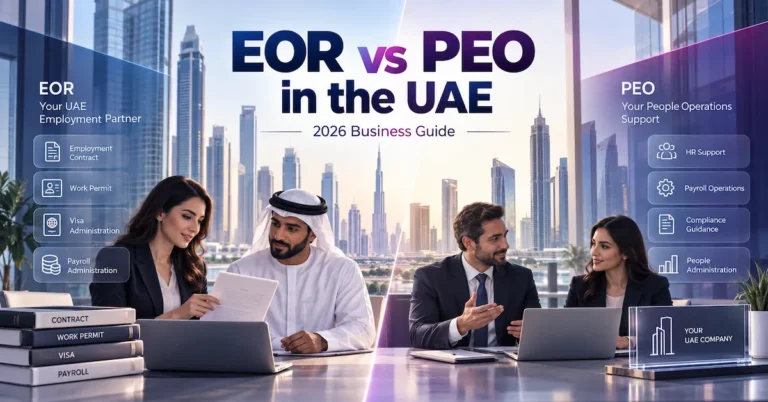
Recruitment finds you the right person. Once the offer is accepted, the candidate becomes your employee, and you’re responsible for their visa, payroll, and legal compliance.
Employer of Record goes a step further. The EOR provider becomes the legal employer on paper, handling visa sponsorship, payroll, and compliance, while the person works exclusively for you day to day.
If you already have a UAE trade licence and just need talent, recruitment alone is usually enough. If you’re entering the UAE for the first time and don’t yet have a legal entity, pairing recruitment with our Employer of Record service lets you hire compliantly without setting up a company first.
10. Industries That Rely Most on Recruitment Services
Certain sectors in the UAE lean on external recruitment far more than others.
- Construction and infrastructure — high-volume blue-collar hiring with tight project timelines
- Hospitality and tourism — seasonal demand spikes and multilingual staffing needs
- Retail and FMCG — frequent turnover and location-specific hiring
- Banking and financial services — compliance-sensitive roles requiring specialist screening
- Healthcare — licensing and credential verification adds complexity most in-house teams aren’t set up for
- Technology and startups — competitive talent pools where speed decides who gets the hire
- Logistics and supply chain — driven by e-commerce growth and warehouse expansion across the Emirates
11. Common Mistakes Businesses Make When Hiring
Writing vague job descriptions. A role that isn’t clearly scoped attracts the wrong candidates and wastes weeks of interviews.
Ignoring salary benchmarking. Underpricing a role against the current UAE market means losing strong candidates at the offer stage, often after weeks of process.
Ignoring notice period realities. Most professional roles in the UAE carry 30–90-day notice periods. Planning a start date without accounting for this creates avoidable delays.
Skipping reference and credential checks. Especially in regulated sectors like healthcare and finance, this isn’t optional and can create serious liability if skipped.
Using unlicensed agencies. Working with a recruitment office that isn’t properly licensed by MOHRE exposes you to disputes with no regulatory backing if something goes wrong.
Treating Emiratisation as an afterthought. Quotas and Nafis targets need to be built into the hiring plan from the start, not addressed after a role is already filled.
12. How to Choose the Right Recruitment Partner
A few questions separate a reliable partner from one that will cost you time later.
- Are they MOHRE licensed and can they show it? This is non-negotiable, not a nice-to-have.
- Do they specialise in your industry, or work generically across everything? Specialisation shows in the quality of the shortlist, not just the pitch.
- What’s their average time-to-shortlist? A partner who can’t give you a straight answer probably doesn’t track it.
- Do they offer a replacement guarantee, and what are the actual terms?
- Can they support you across the GCC, not just the UAE? Useful if regional expansion is even a possibility.
- Do they understand Emiratisation requirements for your sector?
- What does their post-placement support actually look like?
Combuzz HR Solutions works across all of these points as a single accountable partner, combining recruitment with Emiratisation guidance, visa processing, and compliance support so you’re not juggling three vendors for one hire.
13. Emiratisation and Recruitment: What Employers Must Know
Emiratisation is no longer a side conversation in UAE hiring. Private sector companies with 50 or more skilled employees are required to meet specific Emirati employment quotas, with penalties applying for companies that fall short.
The Nafis programme supports this by connecting employers with Emirati jobseekers and offering incentives, including salary support and pension contributions, for companies that hire UAE nationals into private sector roles.
For recruitment, this means building Emiratisation targets into the hiring strategy from the outset rather than scrambling to meet quotas at year-end. A recruitment partner who actively sources Emirati talent, not just fills the quota reactively, makes this considerably easier to manage.
14. Case Scenario: How the Right Agency Changes the Outcome
A mid-sized logistics company expanding into Dubai needed to fill 40 warehouse and driver roles within six weeks ahead of a new contract going live. Their in-house HR team, used to hiring five or six people a year, wasn’t set up for that volume or timeline.
Working with a recruitment partner that specialised in bulk blue-collar hiring, the company had a shortlist for all 40 roles within 10 days, with visa processing running in parallel rather than starting after each hire. The contract went live on schedule, and the replacement guarantee covered two early departures without additional fees.
The lesson here isn’t that agencies are always necessary. It’s that matching the recruitment model to the actual scale and timeline of the need is what determines whether a hiring plan holds up under pressure.
15. Frequently Asked Questions
1. How much do recruitment services cost in the UAE? Most agencies charge a contingency fee of 10–20% of the candidate’s annual salary for permanent placements, payable only once a hire is confirmed. Executive search and retained placements often involve an upfront fee plus milestone payments. Bulk or blue-collar recruitment is usually priced per placement or as a flat project fee. Costs vary by industry, seniority, and how specialised the role is, so it’s worth getting a clear breakdown before signing any agreement.
2. How long does recruitment typically take in the UAE? Standard mid-level roles usually take two to six weeks from brief to signed offer. Executive search can take six to twelve weeks given the confidential, targeted nature of the process. Bulk hiring for blue-collar roles often takes longer overall but moves multiple candidates through in parallel. Timelines also depend on notice periods, since most professional roles in the UAE require 30 to 90 days’ notice before a candidate can start.
3. Do I need a UAE trade licence to use a recruitment agency? Yes, if you plan to employ the candidate directly, you need an active UAE trade licence to sponsor their visa and process payroll. If you don’t yet have a legal entity, pairing recruitment with an Employer of Record service lets you hire compliantly without setting one up first, which is common for companies testing the UAE market before committing to full incorporation.
4. What’s the difference between a recruitment agency and a staffing agency? A recruitment agency sources and places candidates who then join your payroll directly. A staffing agency typically employs workers itself and supplies them to client companies on a contract or temporary basis, remaining the legal employer throughout. Many providers, including Combuzz, offer both models depending on whether you need a permanent hire or flexible short-term support.
5. Are recruitment agencies in the UAE regulated? Yes. Recruitment and staffing agencies must hold a specific licence from MOHRE in addition to a standard trade licence. Domestic worker recruitment is regulated separately under the UAE’s Domestic Workers Law, with strict rules around fee refunds and worker protections. Always confirm an agency’s licence status directly with MOHRE before engaging their services.
6. Can a recruitment agency help with Emiratisation quotas? Yes. A recruitment partner familiar with Emiratisation requirements and the Nafis programme can actively source Emirati candidates for relevant roles, helping companies meet quota obligations proactively rather than reactively. This is particularly valuable for companies with 50 or more skilled employees, who face specific quota requirements and associated penalties for non-compliance.
7. What happens if a placement doesn’t work out? Reputable agencies offer a replacement guarantee, typically covering 60 to 90 days from the candidate’s start date. If the hire leaves or is terminated within that window, the agency sources a replacement at no additional fee. Always confirm the exact terms, including what triggers the guarantee, before signing a recruitment agreement.
8. Is recruitment process outsourcing (RPO) worth it for a growing company? RPO tends to make financial sense once a company is hiring consistently, generally 15 or more roles a year, since the fixed monthly retainer often works out cheaper than paying contingency fees on every individual hire. It also gives you a dedicated recruitment function without the overhead of building one internally.
9. How does hiring differ between the UAE and Saudi Arabia? Saudi Arabia enforces Saudisation quotas through the Nitaqat programme, which affects how many expatriate hires a company can make relative to Saudi nationals. Visa processes, notice periods, and labour law details also differ from UAE federal law. A recruitment partner with genuine on-the-ground experience in both markets, not just UAE knowledge relabelled for Saudi Arabia, is essential to avoid compliance issues.
10. What documents does a candidate need for UAE work visa processing? Standard requirements include a valid passport, passport-sized photographs, educational certificate attestation, a signed offer letter or labour contract, and a medical fitness test conducted in the UAE. Additional documents may be required depending on the role, free zone, or emirate. Requirements can change, so always verify current documentation needs through MOHRE or the relevant free zone authority before starting the process.
11. Can a recruitment agency help with executive-level hires? Yes, this is typically handled through executive search, a more discreet, research-driven process than standard recruitment. It usually involves direct, confidential outreach to senior professionals who aren’t actively job hunting, since most strong executive candidates in the UAE market are approached rather than applying openly.
12. What’s the typical notice period for employees in the UAE? Under Federal Decree-Law No. 33 of 2021, notice periods generally range from 30 to 90 days depending on what’s specified in the employment contract, with 30 days being the minimum for unlimited contracts. This affects hiring timelines significantly, so it’s worth confirming a candidate’s notice period early in the process rather than assuming they can start immediately.
13. Do recruitment agencies handle visa processing themselves? Many do, either directly or in partnership with a visa processing or PRO services provider. This is particularly common for blue-collar and bulk recruitment, where visa processing is bundled into the placement fee. For office-based professional hires, visa processing is sometimes handled separately by the employer’s own PRO team or an external PRO services partner.
14. What industries have the highest recruitment demand in the UAE right now? Construction, logistics, hospitality, healthcare, and technology consistently show the strongest recruitment activity, driven by infrastructure projects, e-commerce growth, and continued expansion of Dubai and Abu Dhabi as regional business hubs. Financial services also maintains steady demand for compliance and risk-focused roles.
15. How is recruitment different across GCC countries? Each GCC country applies its own localisation quotas, Saudisation in Saudi Arabia, Qatarisation in Qatar, Omanisation in Oman, alongside distinct visa processes and labour laws. A recruitment partner needs country-specific knowledge for each market rather than applying UAE practices uniformly across the region, since assumptions that hold in Dubai don’t always hold in Riyadh or Doha.
16. Final Thoughts
Recruitment in the UAE and GCC isn’t just about filling a seat. It’s about finding someone who fits the role, the team, and the legal framework you’re operating under, without creating risk you’ll have to clean up later.
The businesses that get this right tend to have one thing in common: they treat recruitment as a partnership, not a transaction. They pick an agency that knows the market, stays current on MOHRE regulations, and stands behind its placements when things don’t go to plan.
Whether you’re hiring your first employee in Dubai or scaling a team across the GCC, getting the recruitment process right from the start saves you far more than it costs.